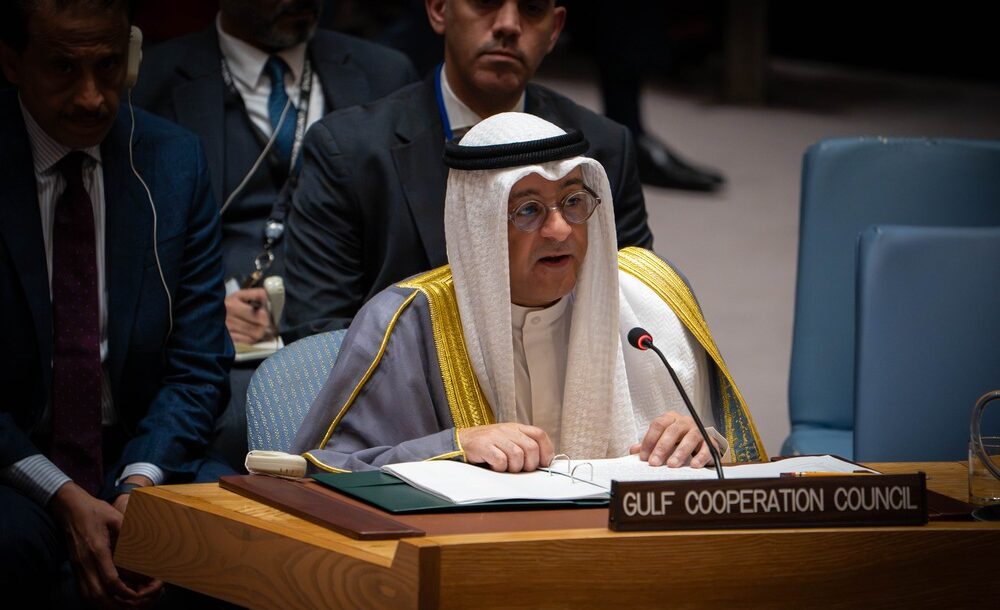

New York: The Gulf Cooperation Council (GCC) has reaffirmed its firm rejection of any violations of the security, sovereignty and territorial integrity of its member states, calling on the United Nations Security Council to ensure an immediate end to attacks targeting the region.
Addressing the UN Security Council in New York, GCC Secretary-General H.E. Jassim Mohammed Al Budaiwi presented the unified Gulf position on regional developments and their impact on international security, maritime navigation and global economic stability.
H.E. Al Budaiwi said GCC countries have faced repeated attacks since February 28, 2026, amid the ongoing regional conflict. These attacks have targeted airports, ports, energy facilities, electricity networks, water desalination plants, residential areas and other civilian infrastructure.
Read More
He said the attacks have resulted in deaths, injuries and extensive infrastructure damage, while also causing serious environmental consequences in the Arabian Gulf.
Condemning the attacks as violations of international law, H.E. Al Budaiwi stressed that GCC countries have consistently pursued diplomatic efforts to prevent further escalation.
He welcomed UN Security Council Resolution 2817 of 2026, which condemned military attacks against GCC countries and Jordan and demanded their immediate cessation. He urged the Council to ensure the resolution’s implementation and prevent further attacks, also referring to UN Human Rights Council Resolution 61/1 of 2026.
Highlighting the wider consequences of the conflict, H.E. Al Budaiwi warned that disruptions to maritime navigation in the region could have devastating effects on global supply chains, trade and food security.
He said interruptions to shipping routes have affected the movement of essential goods, food supplies, fertilizers and ammonia, raising concerns over global inflation and the risk of severe food shortages, particularly in developing and vulnerable countries.
The GCC chief stressed that protecting international shipping lanes is a shared global responsibility, as disruptions in one region can affect industries, businesses and consumers across continents.
Referring to the 1982 United Nations Convention on the Law of the Sea, he highlighted the right of transit passage through international straits and the need to safeguard freedom of navigation while respecting the sovereignty of coastal states.
He also recalled Security Council Resolution 552 of 1984, adopted during the tanker crisis, underscoring the Council’s responsibility to protect maritime navigation and international security.
Turning to broader regional developments, H.E. Al Budaiwi reaffirmed the GCC’s support for the Palestinian cause and the establishment of an independent Palestinian state based on the June 4, 1967 borders, with East Jerusalem as its capital.
He also reiterated the Council’s support for Lebanon’s sovereignty and the extension of state authority across its territory in accordance with UN Security Council Resolution 1701.
On Syria, he stressed the importance of preserving the country’s sovereignty, unity and stability.
Regarding Yemen, Al Budaiwi reaffirmed the GCC’s commitment to the country’s sovereignty and territorial integrity, expressing support for UN-led efforts to achieve a comprehensive political settlement. He also condemned violations against United Nations personnel and humanitarian workers.
Concluding his address, the GCC Secretary-General emphasised that dialogue and diplomacy remain the preferred means of resolving regional crises.
He reaffirmed the Gulf states’ willingness to build relations with Iran based on mutual respect, good neighbourliness, respect for sovereignty and non-interference in internal affairs.





