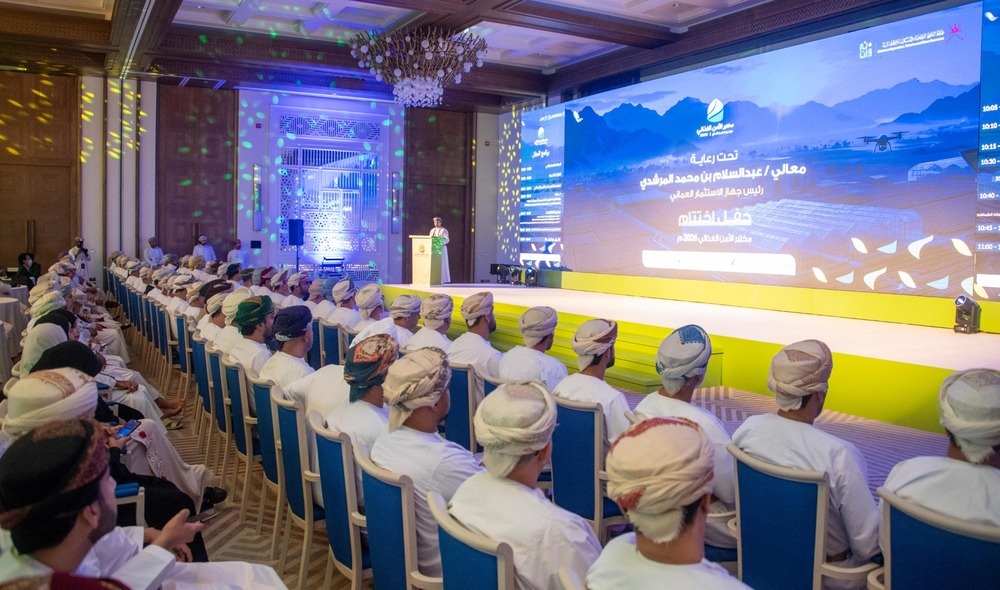

MUSCAT : The Food Security Lab 2026 concluded its activities with the adoption of major investment projects and initiatives aimed at strengthening the Sultanate’s food security and achieving its target of localising a second billion Omani riyals in the food sector.
The closing ceremony was held under the patronage of H.E. Dr. Abdul Salam bin Mohammed Al Murshidi, Chairman of the Oman Investment Authority.
Dr. Masoud bin Sulaiman Al Azri, General Supervisor of the Food Security Lab 2026, said the initiatives would help increase local production, attract investment and strengthen food-related industries.
Read More
- Oman signs RO 51 million shrimp farming deal in Al Wusta, targets 30,000 tonnes annually
- Oil prices rebound as shipping attacks fuel supply fears
- Gold prices rebound after sharp fall
- MCBS makes its debut in the Times Higher Education Arab University Rankings 2027
- ITQAN Forum to inspire young Omanis to discover their potential and shape their future
He emphasised that creating a favourable investment environment and improving supply chain efficiency were essential to achieving the localisation target and increasing the food sector’s contribution to the national economy.
Eng. Asma bint Hamoud Al Hinai, Director of the Oman Vision 2040 Implementation Follow-up Office at the Ministry of Agriculture, Fisheries and Water Resources, said the laboratory had developed a roadmap for food security programmes under the Eleventh Five-Year Plan (2026–2030).
The roadmap covers nine major programmes focusing on food and water security, the blue economy, sustainable agriculture and fisheries, scientific research, innovation and food safety.
According to Al Hinai, the food security investment programme now comprises 376 projects valued at approximately RO 899 million across four major sectors.
These include 158 agricultural projects worth RO 77 million, 75 livestock projects valued at RO 261 million, 98 fisheries projects worth RO 178 million and 45 water resources projects valued at RO 383 million.
The laboratory also identified 25 priority commodities for local production, including vegetables, fruits, grains, legumes, vegetable oils, meat, dairy products, fish and water, to improve self-sufficiency levels by 2030.
As part of efforts to strengthen Omani food exports, the laboratory proposed establishing a specialised unit for production forecasting and export logistics coordination, alongside programmes to meet international standards, access overseas markets and identify products with strong export potential.
Other initiatives include developing an investment map for aquaculture, strengthening fish and animal feed industries, improving value chains and introducing smart digital platforms and artificial intelligence to support decision-making.
The laboratory also approved measures to regulate food imports, streamline shipping procedures, introduce alternative financing options for strategic projects and prepare customs exemptions for machinery and equipment used in food security projects.
The closing ceremony witnessed the signing of 10 agreements supporting investment and value-added food industries.
Among the major projects was an RO 28 million Omega-3 production facility by Omega Arabia, which will manufacture products from refined fish oil on a site covering approximately 29,888 square metres.
Another agreement involved New Crown Investment establishing an integrated factory for mineral water, carbonated beverages, soft drinks, dairy products and tomato products, with an investment of approximately RO 1.554 million across 10,000 square metres.
Al Ataa Food Industries will also establish a frozen and semi-fried potato processing facility worth RO 600,000 on a 5,243-square-metre site to support local market demand and agricultural value addition.
The agreements included projects involving Khazaen, represented by its CEO, Eng. Salem bin Sulaiman Al Dhahli.
The laboratory’s workshops and discussions focused on overcoming investment challenges, strengthening public-private partnerships and adopting modern technologies to improve production efficiency and ensure sustainable food supply chains.
For all the latest news from Oman and GCC, follow us on Twitter, Instagram and LinkedIn, like us on Facebook and subscribe to our YouTube page, which is updated daily.





