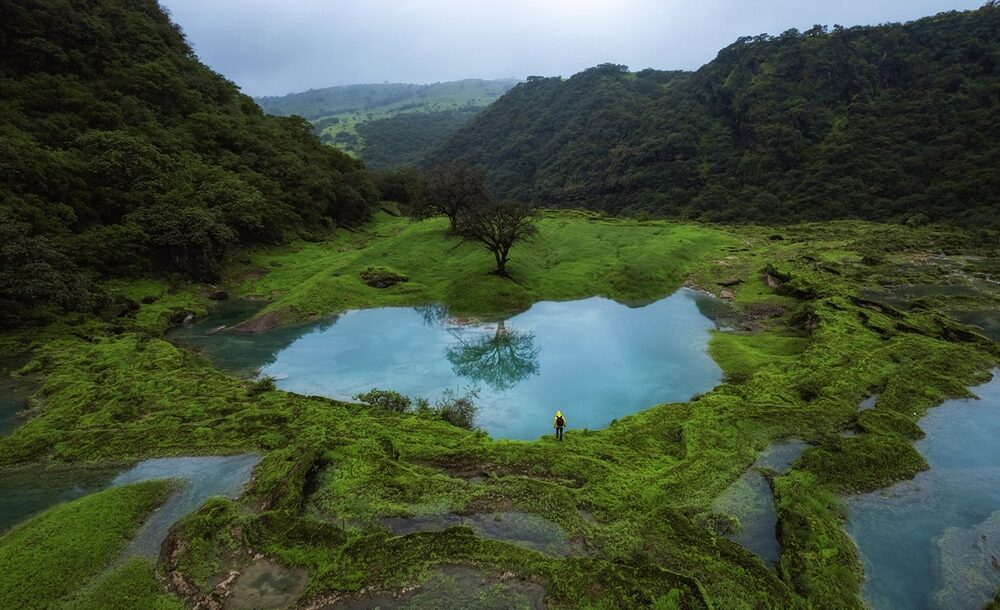

MUSCAT : Oman is studying whether the dense fog that blankets Dhofar’s mountains during the annual Khareef season could be developed into an unconventional source of water, with researchers building a long-term database to assess its harvesting potential.
Al Shaimaa Al Siyabi, Project Engineer at the Artificial Rain Enhancement Center at Ministry of Agriculture, Fisheries and Water Resources, said a two-year research project is collecting ground, weather, satellite and geographical data to determine how much water could potentially be extracted from fog across Dhofar Governorate.
Speaking on Al Sawt Podcast, the Arabic platform of The Arabian Stories, Al Siyabi said the concept of harvesting fog was not new to Dhofar, with traditional practices dating back generations.
Read More
- Youth are the pillar of Oman’s development and future, says minister
- His Majesty Sultan Haitham issues decrees amending Council of Oman, Shura election laws
- Oman moves to ensure essential goods supply, price stability as CPA meets retailers
- 13 expats arrested for gambling in Muscat
- His Majesty Sultan Haitham expresses condolences to Jordan King over church attack
According to accounts shared with the research team, communities in Dhofar historically built large structures and dug circular pits around them to help capture and condense moisture from fog. The collected water accumulated around trees and provided water that could be used by animals in mountainous areas.
Previous attempts to harness fog water have also been undertaken by the Environment Authority and local communities, she said.
Advances in technology, however, are allowing researchers to examine the potential of fog harvesting on a larger and more scientific scale.
The current project aims to establish a long-term database measuring the volume of water that can be collected during the Khareef, taking into account seasonal variations from year to year.
“The intensity of the Khareef varies from one year to another,” Al Siyabi said, adding that understanding those changes would be critical to estimating the reliability of fog as a future water resource.
Researchers are using internationally standardised fog collection nets measuring one metre by one metre to capture moisture. The amount of water collected is continuously recorded on an hourly and daily basis.
The ground measurements are then combined with satellite information, including cloud cover and fog density, as well as data from weather stations measuring wind speed, temperature, humidity and solar radiation.
Geographical information systems and maps covering Dhofar’s mountains, plains and other terrain are also being incorporated into the research.
Al Siyabi said the project currently covers nine sites with 12 monitoring stations.
The data will eventually be used to develop a predictive model covering Dhofar’s mountain range, allowing researchers to estimate how much fog water could potentially be harvested across different locations.
The project is expected to run for two years and researchers currently have preliminary findings from its first year.
Al Siyabi said further data would be needed before firm conclusions could be drawn about the volume of water available and how it could be utilised.
The research could ultimately help determine whether one of Dhofar’s most distinctive climatic features can contribute to Oman’s future water resources, particularly as the country explores unconventional and sustainable sources of water.
For all the latest news from Oman and GCC, follow us on Twitter, Instagram and LinkedIn, like us on Facebook and subscribe to our YouTube page, which is updated daily.





