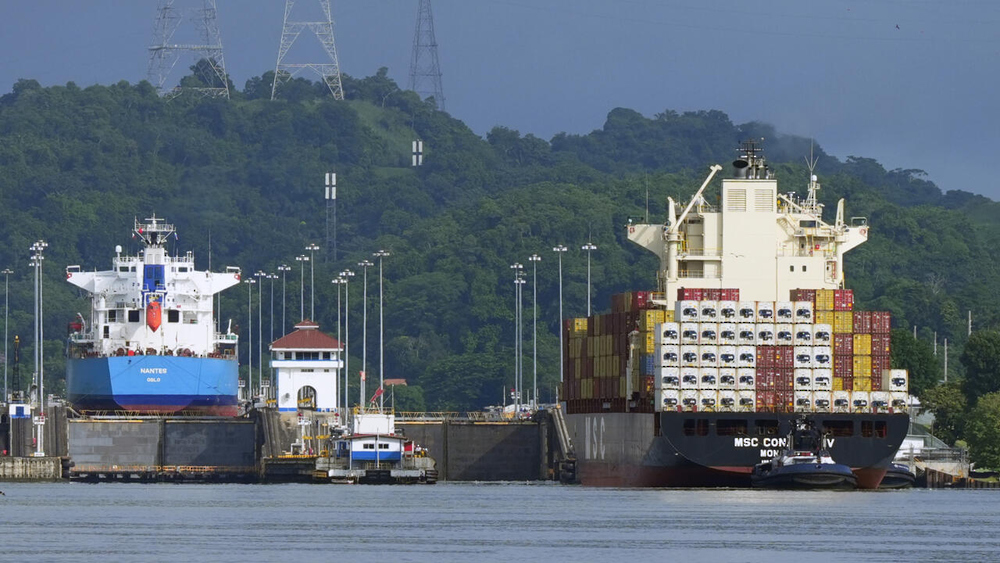

Panama: The Panama Canal Authority said daily ship transits would be progressively reduced from 36 to 34 in early September before falling further to 32 vessels a day from September 15.
The restrictions come after unusually low rainfall reduced water levels in the artificial lakes that supply the canal and provide the freshwater needed to operate its lock system.
Rainfall across the canal watershed between May and August was 34 per cent below the historical average, while water flowing into the watershed was 44 per cent below normal levels, according to canal authorities.
Read More
- IndiGo cancels Riyadh flights until October 31, 3 other Saudi routes until October 27 amid evolving security situation
- UAE closes all beaches in Umm Al Quwain after tanker oil spill detected
- Earthquake of Magnitude 7.0 Strikes Tibet; 16 Dead, 32 injured
- Nigeria reports first imported Ebola Bundibugyo case in Abuja: WHO
- US midterm voting begins in Texas as Democrats target historic gains
Despite the arrival of Panama’s rainy season, officials said the lower-than-expected precipitation had made further conservation measures necessary to protect the long-term operation of the canal.
El Niño is a naturally occurring climate phenomenon that typically develops every two to seven years and is associated with warmer-than-normal surface waters in the central and eastern tropical Pacific Ocean. It can trigger major changes in rainfall, winds and atmospheric conditions around the world.
Forecasters expect the 2026-27 El Niño to become particularly strong, raising concerns that drought conditions across Central America could worsen in the coming months.
The impact is already being felt beyond Panama, with drought conditions affecting several parts of Central America.
The 80-kilometre Panama Canal, which links the Atlantic and Pacific oceans, is one of the world’s most strategically important shipping corridors. Roughly 5 per cent of global maritime trade passes through the waterway, with the United States and China among its biggest users.
Authorities have also introduced other water-saving measures, including restrictions on ships’ maximum draft — the vertical distance between the waterline and the lowest point of a vessel’s hull. Limiting draft can reduce the amount of cargo ships are able to carry but helps the canal continue operating when reservoir levels fall.
The latest restrictions revive memories of the severe 2023-24 drought, when the Panama Canal was forced to progressively slash its transit capacity. At one stage, authorities planned to reduce crossings to as few as 22 vessels per day, compared with normal operating levels of around 36 to 38 ships.
With El Niño yet to reach its expected peak, canal authorities have warned that further restrictions cannot be ruled out if rainfall remains insufficient.
Any prolonged disruption could have consequences far beyond Panama, forcing shipping companies to wait longer for transit slots, carry smaller loads or reroute vessels along significantly longer journeys.





