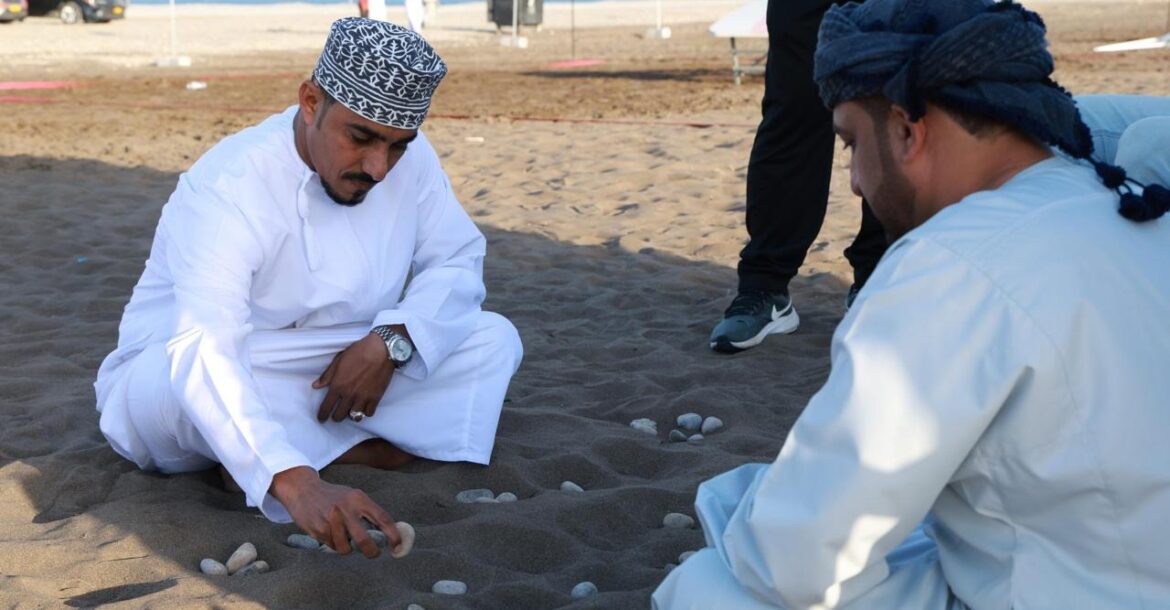

Muscat: The Ministry of Culture, Sports and Youth has intensified efforts to protect and promote traditional games through initiatives focused on identification, documentation, and regulation. These efforts form part of a broader strategy to preserve Oman’s cultural and civilizational heritage, strengthen intergenerational ties, and work towards including these games on the list of intangible cultural heritage.
Traditional Omani games have long played a vital role in society, serving as a form of entertainment while also helping children develop physical, mental, and social skills. They embody values such as cooperation, fair competition, and community spirit, while reinforcing a sense of belonging and national identity.
Among the most prominent of these games is Al-Hawalis, a traditional Omani game known for its reliance on intelligence and precise calculation. Often compared to chess, the game is played between two players using 28 holes dug in the sand or marked on a board, along with small pebbles or seashells. Players aim to capture their opponent’s pieces by moving them through specific paths, with victory going to the player who captures all of the opponent’s shells.
Read More
- Real Madrid beat Barcelona 2-1 to close gap at top of LaLiga
- Indian Olympic Association announces Indian contingent for Dakar 2026 Youth Olympic Games
- Australia release Maddinson, Harper ahead of Cape Town Test; Smith faces fitness test
- PV Sindhu enters French Open final after thrilling victory over Japan’s Akechi
- Aston Villa beat Manchester City as Arsenal close in on Premier League leaders
Salem bin Juma Al Sinani, Vice President of the Omani Traditional Games and Sports Team at the ministry, told the Oman News Agency that Al-Hawalis remains widely practiced, particularly in coastal wilayats across various governorates. He noted that the game features prominently in community events such as Muscat Nights in Quriyat, alongside other traditional games including Al Sayyad, Al Yous, Al Atraj, Al Lakad, and Daq Al Hasa.
Al Sinani added that Al-Hawalis requires a high level of focus and strategic thinking, underscoring its similarity to chess. He also highlighted the ministry’s efforts to register the game with UNESCO, citing its significance in safeguarding Oman’s intangible cultural heritage.
Meanwhile, Mohammed bin Khalfan Al-Mushrafi, President of Quriyat Club and Chairman of the Supervising Committee for Muscat Nights events in Quriyat, said the inclusion of folk games in Muscat Nights 2026 aims to showcase Oman’s authentic heritage and familiarise younger generations with its cultural value. He explained that Al-Hawalis was deliberately included among the events held on Quriyat’s beachfront due to the strong public interest and enthusiastic participation it continues to attract from local communities.





