
Muscat: Officials say the zone is now witnessing one of its strongest periods of growth, supported by strategic reforms, institutional transformation and an expanding investor base.
Engineer Ahmed bin Ali Akak, CEO of SEZAD, confirmed that the zone has begun activating its new strategic pillars, localizing investments, enhancing operations and management, improving lifestyle standards, attracting global partners and tourists, and advancing institutional excellence. He said the strategy prioritizes marketing and fast-tracking sub-zones across key sectors, while strengthening tourism development and renewable energy investments.
He noted that several workshops were held this year to align the administration teams with the strategy’s objectives, coinciding with the launch of an institutional transformation program and a refreshed identity aimed at elevating employee efficiency, investor experience and global perceptions of Duqm.
Read More
- Oman’s FSA warns audit firms against assigning work to unregistered staff
- Oman’s Sohar Power appoints Ameer Abdul Hussain as CEO
- Bank Muscat celebrates Omani Women’s Day with exclusive offers
- Muscat Stock Exchange hosted the Federation of Euro-Asian Capital Markets Conference “ConFEAS 2026”
- IMF raises 2026 global growth forecast to 3.1%, sees 3.4% in 2027
The strategy is being implemented at a time when the zone is recording strong investment momentum. By the end of June, committed investments rose to RO 6.323 billion, marking 5.3% growth from June 2024. This, he said, reflects Duqm’s competitive environment, investor incentives and the value of government-built infrastructure.
A number of major projects are now progressing across real estate, green industries and renewable energy. The Misan Square Duqm integrated business complex has reached 80% completion, while Jindal Steel’s green steel plant has achieved 26% progress. In the green hydrogen sector, Acme’s green ammonia facility, designed to produce 100,000 tonnes annually, is 17% complete, with Phase 1 scheduled for July 2027.
The first half of this year also saw the launch of Phase 1 of the Mawared Turbine wind turbine manufacturing project, worth over RO 70 million. With an annual production capacity of up to 1,000 MW, the plant will produce turbines ranging from 6.25 MW to 9.6 MW. Commercial operations are expected in 2026, creating over 1,000 jobs.
Infrastructure development is advancing at pace, with major road networks nearing readiness. Traffic has opened on the 51-km dual road between Duqm Airport and Ras Markaz crude storage tanks. The Sultan Said bin Taimur dual carriageway is 94% complete, while National Road 32 has reached 83% completion in its first phase and 58% in the second. A new 16-km coastal road has also been awarded to boost tourism and link key maritime and industrial sites.
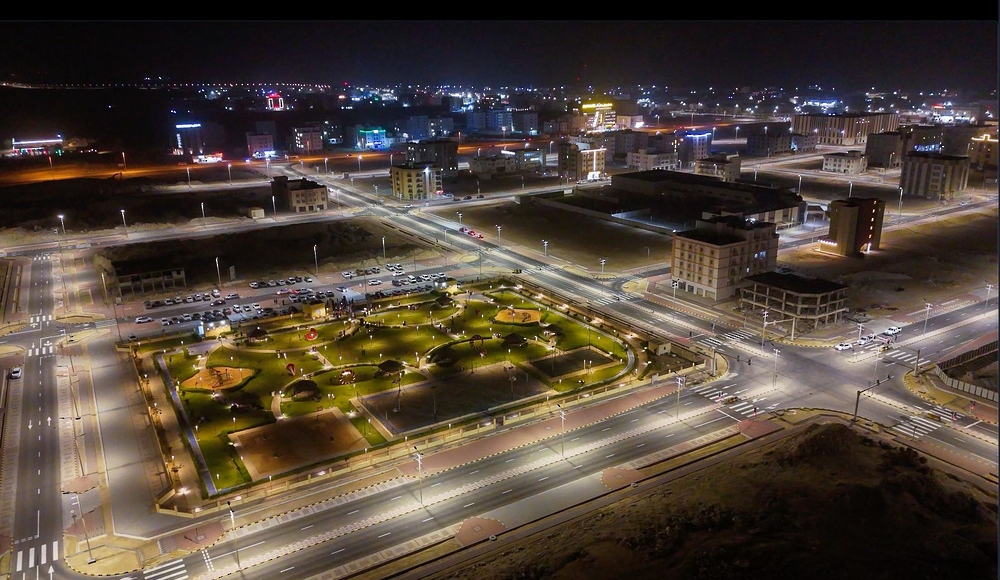
Efforts to create a livable and investment-ready city are equally underway. The commercial district park (13,000 sqm) has been completed along with internal roads, sewage and drainage systems, irrigation upgrades on Airport Street, and enhancements to the beach park. A multi-purpose community entertainment complex, now 95% complete, will soon serve residents and workers with social, recreational and event spaces overlooking the beach.
The zone’s performance indicators this year show substantial growth. New usufruct agreements worth RO 22.6 million were signed in the first half of 2025, while investment applications rose to 19, up from 7 last year. Commercial registrations surged from 68 to 225, and more than 1,000 licenses of various types were issued. Workforce numbers climbed to over 12,400, including 3,245 Omanis, raising the Omanization rate to 26%, up from 20% a year earlier.
SMEs are also benefiting from Duqm’s expanding ecosystem. By June, 541 micro, small and medium enterprises were operating in the zone. The authority has cut service fees by 50% and continues to support SMEs through training programs and close performance monitoring.
Engineer Akak emphasized that SEZAD is moving steadily toward becoming a fully integrated, attractive and sustainable city, “a place ready for work, living and long-term growth”.





