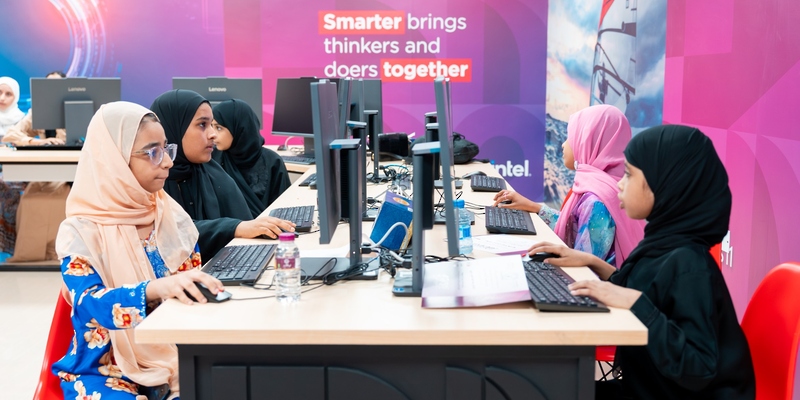

Muscat: Supported by the High Seas Company, this state-of-the-art facility is designed to harness AI technologies, align with global technological advancements and transform the educational landscape.
Dr. Faisal bin Ali Al Busaidi, Director General of Information Technology at the Ministry, highlighted that the laboratory is a key initiative under the ministry’s executive program for integrating AI into school education. It aims to empower students and educators through training, scientific research, and innovative applications.
The AI lab comprises two halls: one dedicated to training and the other focused on developing practical applications. This setup allows students and teachers to engage with AI tools and devices, enhancing their understanding of AI concepts and fostering an environment ripe for exploration and experimentation.
Read More
- IMF sees Oman’s economic growth accelerating to 4.5% in 2026
- HH Sayyid Theyazin presides over Sultan Qaboos University’s 40th anniversary
- Oman elected Vice-Chair of WHO Working Group on Pandemic Agreement
- Oman and Saudi Arabia sign Hajj agreement for 1448 AH season
- Oman, Liberia sign agreement to establish diplomatic relations
Dr. Walid bin Taleb Al Hashemi, Director General of the Directorate General of Education in North Al Batinah, elaborated on the lab’s objectives. It aims to create an interactive learning environment, equipping students and teachers with essential programming and data analysis skills. Participants will have opportunities to develop simple programming models and apply machine-learning techniques to real-world challenges.
In addition to providing workshops and training programs, the lab will also house a production unit dedicated to creating educational content using AI. Discussion panels and dialogue sessions focused on AI’s societal impact are planned, ensuring that all stakeholders—students, teachers, and employees—benefit from this innovative initiative.
Equipped with advanced technology, the laboratory features multiple computers, interactive screens, and 3D printers. Internet of Things (IoT) capabilities have been integrated, enabling remote air conditioning and lighting management, while sensors monitor user traffic. Additionally, voice-activated “Alexa” devices assist with operational commands and respond to inquiries, showcasing the lab’s commitment to leveraging technology for a better educational experience.





