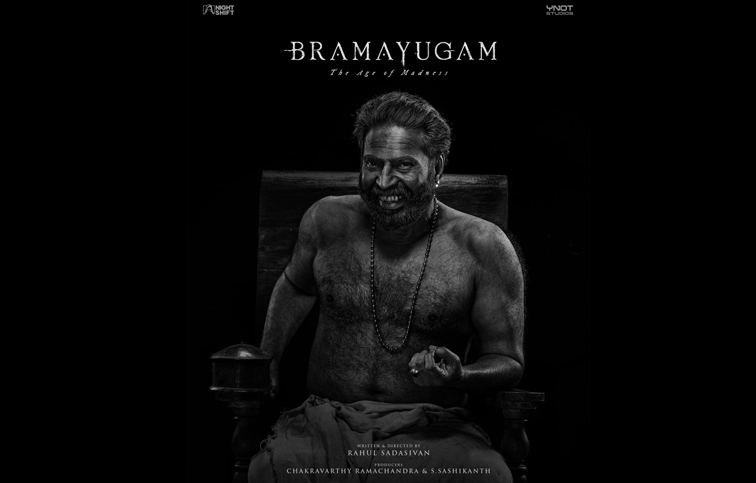

Over the years, we have seen Mammootty adorn the skin of many distinct characters. But as time ebbs and flows and as Kodumon Potti (Played by Mammootty) says, “Kaalam pole kalangi marinja oru puzha vere illa, athu thirinjum marinjum ozhukum” which translates to time being viewed as a river that flows through every crevice and depth, so has Mammootty in Rahul Sadasivan’s ‘Bramayugam’.
Having a distinct portrayal of the horror and psychological thriller genre called “Bhoothakaalam” under his belt, Rahul Sadasivan takes a bold stride towards creating an industry-new take on mythology and allegory with Bramayugam.
With breathtaking frames by Shehnad Jalal and production by Night Shift Studios and YNOT Studios, we are immersed in the black-and-white world of the 17th century, where every colour is determined by the viewer.
Read More
- KS Harishankar to headline Ultimate Music Fiesta in Muscat on November 6
- Superstar Rajinikanth’s ‘Jailer 2’ sets Oman cinemas on fire with over 20 shows a day
- Veteran Indian actor Nana Patekar dies at 75
- Ayushmann Khurrana and Sara Ali Khan bring the energy to Chandigarh ahead of Udta Teer
- One Feeling at a Time: Talwiinder begins his ‘Paiinted Feeliings’ journey with ‘Assay Passay’
Bramayugam is highly inspired by the folklore collection “Aithihyamala”, with the character named Kunchamon Potti, targeting the nerves of anxiety we never knew we had.
Bramayugam establishes the depth of the story with Kora (played by Manikandan Achari) and Thevan (A humble folklore singer, played by Arjun Ashokan) lost in the forest with nothing but a flame to keep them sane. Thevan’s friend, through his eyes, leads us to the dense fog of uncertainty where he says, “There is something here”, instantly gripping the viewers to the Yugam (Age) of the dark ages of Kerala, as mentioned by Rahul Sadasivan before the movie released.
This Yuga or age right before Kali Yuga which is believed to be “the age of Kali”, “the age of darkness”, “the age of vice and misery”, or “the age of quarrel and hypocrisy” seeps deep into the characters and brings out an eerie heaviness that propels the viewer’s journey.
As Kora gets lost in the enchantment of the forest and falls prey to an evil spirit, Thevan runs for his life and finds himself at the doorstep of an ancestral home.
The lush forest around deepens as the frames turn darker, with every second indicating an impending loom that awaits the recipient. The grey area of ages awaits Thevan as one Yuga or age before Kali Yuga. Nothing is black or white about the concept, but the era of madness is always in the grey, connoting innocence, and betrayal.
Thevan, confused and hungry, meets the palace caretaker/cook (played by Sidharth Bharathan), who tells him that once you set foot on this property, you never leave.
If there is anyone who can convince you that the actor doesn’t exist anymore but the character, it’s none other than Mammootty. Kodumon Potti (played by Mammootty) greets the lowly singer who is ashamed to be in the presence of a great master. Through witty lines, the writers immerse you in a time where cast and societal position had been a Yugam Kerala was part of.
The lines and emotions conveyed by Kodumon Potti and his disgust towards the cook while being elusive towards Thevan sarcastically put forth a request through demand, using the weapon called fear, masking a gesture of commanding. This also speaks to the practice of untouchability in the “Kairalik” history, manipulative techniques that are forbidden from the textbooks. The fact that in the untouchability era, it was easier to manipulate the lower cast to get them to obey the orders sent down from the upper cast gets conveyed with every smirk and breath effortlessly given by Mammootty.
Offering Thevan a place to stay, Kodumon Potti wagers with the lowly folklore singer over a game of Pakida (a board game), where Kodumon Potti asks Thevan to wager his freedom and time. With a sleight of hand and magic, Thevan is tricked into losing the game and is enslaved by Kodumon Potti and the time that flows according to the master’s command over the house and everything around it. The wager of winning back his freedom looms heavily on Thevan until the end, before he realises it’s too late.
Rahul Sadasivan expertly weaves a subliminal message for the viewers who are well-versed with another master at the dice game named Shakuni from the Mahabharata. Shakuni, who had sway over the dice game through skill and a lie, made Pandavas lose their kingdom. Juxtapositioning that with Kodumon Potti and Thevan, we see a mind-thriller combination of horror take birth, drawing the fabric of our culture and history.
With no knowledge of time, and as Kodumon Potti hysterically says before the intermission, “You don’t have permission to leave”, we, along with Thevan, are sucked into the madness that is Bramayugam. Psychologically, Kodumon Potti, by swinging from overtly welcoming to a state of anger and hate, traps Thevan in confusion. By giving respect beyond what was ever shown by those in the upper cast, Kodumon Potti entraps the lowly Thevan with deceit.
The writers expertly weave out the history behind the ancestral home and an era that still leaves traces of magic to this time and age. With the enchantment of allegory and culture, we are introduced to the lineage of Kodumon Potti, who enslaved a Chathan (goblin) gifted by Varahi Devi, one of the Sapta matrikas.
With the power to shapeshift, the goblin takes over the form of the last of the bloodline of Kodumon Potti, killing the actual master of the house. As the goblin is drunk with power and lust, it entraps everyone in the palace’s vicinity with the curse of time, which grips you, as the goblin in the shape of Kodumon Potti tells Thevan, “Death is a blessing, after which, everything ends.”
Rahul Sadasivan creates a triangular effect between the three main characters, working to create a ripple effect that keeps us hooked till the very end. Riddled with fear and confusion, Thevan and the cook concoct a plan to entrap the goblin. But their confrontation with the goblin leads to a conflict between themselves. The initial confusion created by the goblin is now psychological, restricting them from looking beyond themselves and making it impossible for the cook to search for reason. As the palace catches fire, the three sink under the rubble, making you guess for a moment that death, indeed, was the blessing.
“Men may come, men may go, but I go on forever”, an infamous line from ‘The Brooks, by Alfred Tennyson’, offers an eerie resemblance in Bramayugam. As we reach the end of this twisted tale, we see the beginning of a new Yugam, as the cook escapes the clutches of death only to meet his fate as he gets shot by the Portuguese, who signify the start of a new era. As the cook utters the last word, “Lightening”, predicted by the goblin who cursed the cook that he would be struck by lightning, he gently gets wiped away by the brook, painting the era of a new man. The power of sadism touches a nerve of psychological manipulation you never thought was possible as the goblin emerges in the skin of Thevan, tricking the viewers and emerging victorious, indicating the stance of being immortal as he glances at the brook that flows irrespective of the Yugam, even in the era of the new man and solidifying in the hearts of every viewer that Arjun Ashokan has probably given a career-best performance of his life.
This haunting yet comforting feeling of knowing that some things never end, yet give way to something mystical and beautiful, gives power to every topic expressed through the character of Rahul Sadasivan. Psychology, Folklore and Mythology build the foundation of Bramayugam and show that sometimes all you need is a sleight of hand to create an unforgettable story that has the power to exist for ages to come.





