
MUSCAT: Oman marks its National Day on Friday with a stronger balance sheet and a development plan that calls for the private sector to take a greater role in investment and job creation. The latest growth figures show the scale of that task. The economy grew 5.1% in the second quarter, with oil activity up 14.7% and non-oil activity rising 0.7%.
The annual observance on Nov. 20 comes as His Majesty Sultan Haitham bin Tarik’s government implements its 2026–2030 development plan, the 11th in a series of five-year plans. It advances the goals of Oman Vision 2040, which include diversifying sources of income, improving public services and expanding employment opportunities for Omanis.
A stronger balance sheet
Real economic growth averaged about 3.2% a year from 2021 to 2025, according to a Vision 2040 progress report. Private and foreign investment played a greater role in the economy, while public debt fell to 34.6% of gross domestic product from 65.9% over the period covered by the review. Oman also regained its investment-grade credit rating.
Read More
- Oman National Day: Beyond Khareef, Dhofar looks to ports and wind power for growth
- His Majesty Sultan Haitham presides over Oman National Day military parade in Izki
- GCC landmarks light up for Oman’s National Day
- Dawoodi Bohra community marks Oman National Day in Muscat
- Rain falls across parts of Muscat, with showers possible in Hajar and Dhofar
S&P Global Ratings affirmed Oman’s BBB- rating with a stable outlook in September and raised its forecast for real GDP growth in 2026 to about 3.5%. The agency projected a fiscal surplus of 4.8% of GDP for the year. Foreign exchange reserves stood at about $19.5 billion at the end of June.
Government revenue rose 16% to 9.828 billion Omani rials in the first nine months of 2026, from 8.481 billion rials a year earlier. Spending reached 9.738 billion rials, leaving a budget surplus of 90 million rials. Public debt fell by about 600 million rials by the end of September, and the Finance Ministry paid 1.434 billion rials in outstanding dues to private companies.
Ports, industry and finance
Non-oil activity grew about 1.3% year on year in the first half, according to S&P. Wholesale and retail output rose 5% at current prices to 1.735 billion rials over the same period, while foreign investment in the sector increased 9.7% to about 305 million rials.
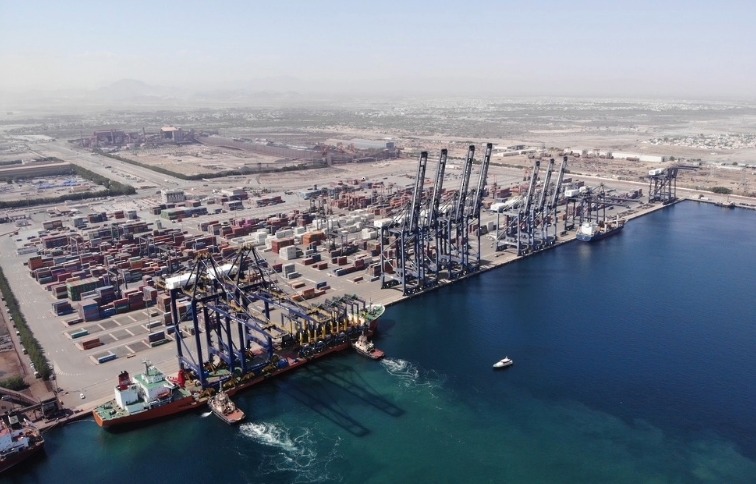
Cargo volumes rose 15% at the Port of Salalah and 52% at the Port of Sohar in the first half. In Duqm, Oman opened a 51-km dual carriageway linking the airport to the Ras Markaz crude oil storage terminal and launched the first phase of a wind turbine manufacturing project. The project represents an investment of more than 70 million rials and is designed to produce turbines with a combined capacity of up to 1,000 megawatts a year. Renewables accounted for 9% of total energy consumption, according to the Vision 2040 review.
Oman also established the Oman International Financial Centre by royal decree this year. The centre aims to attract regional and international banks, insurers and investment firms, including providers of Islamic financial services. Its plan is to connect businesses and investors across the Gulf, South Asia and East Africa and create specialist jobs for Omanis.
Jobs and public services
The Ministry of Labour reported 53,525 opportunities across recruitment, the replacement of expatriate workers with Omanis, and training tied to employment by the end of September. That was 89% of its annual target.
Social protection programmes reached more than 1.5 million beneficiaries by the end of 2025. The 2026 budget earmarked about 614 million rials for the system and set aside funding for subsidies on electricity, water, transport, food and petroleum products.
In healthcare, the government opened referral hospitals in Al Suwaiq and Khasab in January, along with the Central Public Health Laboratory in Seeb. The Al Suwaiq hospital cost more than 75 million rials and opened with 260 beds, with room to expand. A new hospital opened in Mahout in April at a cost of 17 million rials, and construction plans for Al Nama Hospital in North Al Sharqiyah moved forward in May with the laying of its foundation stone.
Oman rose eight places to 47th on the Global Innovation Index’s measure of the conditions that support innovation, while remaining 69th overall among 139 economies. It ranked ninth for net foreign direct investment inflows as a share of GDP.
Diplomacy and trade
His Majesty Sultan Haitham’s visits this year included France, Botswana, Angola, Kazakhstan, the United Kingdom, China and Brunei. The trips produced agreements and memoranda covering trade, investment, culture and scientific cooperation.
At the United Nations General Assembly in New York, Oman reiterated its commitment to respecting state sovereignty and resolving disputes through dialogue. It also called for efforts to ease regional tensions and protect freedom of navigation under international law.
At home, the development plan through 2030 calls for more efficient public spending, a broader role for private businesses and more jobs for Omanis. The pace of non-oil growth and the number of Omanis finding work will be two measures of how far the plan delivers.