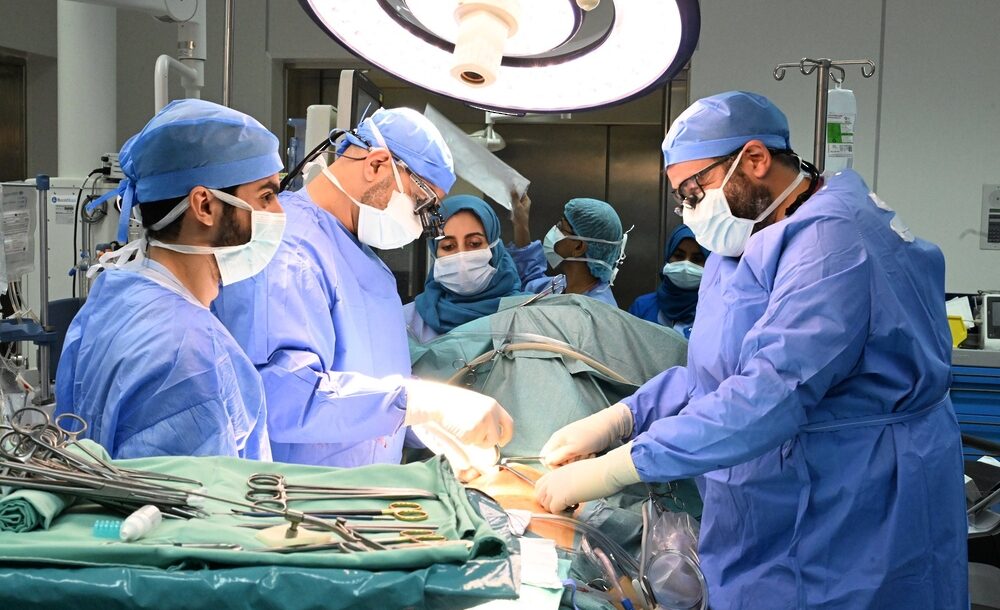

Muscat: The Omani Center for Organ and Tissue Donation and Transplantation said organs retrieved from a patient declared brain dead were successfully transplanted into four patients, giving them a new chance at life.
The achievement reflects the growing coordination and readiness of Oman’s government and military healthcare system, including government hospitals, University Medical City and the Medical City for Military and Security Services.
It also underlines the progress made by national specialised medical teams in carrying out highly complex transplant procedures.
Read More
- Youth are the pillar of Oman’s development and future, says minister
- His Majesty Sultan Haitham issues decrees amending Council of Oman, Shura election laws
- Oman advances nine places in 2026 Global Marsh Pension Index
- Oman moves to ensure essential goods supply, price stability as CPA meets retailers
- 13 expats arrested for gambling in Muscat
Dr. Noureen bint Yousef Al Balushi, Director of the Omani Center for Organ and Tissue Donation and Transplantation, said the ability to repeat such procedures within a relatively short period shows that Oman’s transplant system has entered a more mature and organised phase.
She said the success was no longer an isolated achievement, but the result of an integrated system beginning with the early identification of potential donors, followed by medical assessment, preservation of organs and rapid coordination between retrieval and transplant teams.
Dr. Noureen said saving four patients from a single donor required precise diagnosis of brain death, early identification of the donor and careful preservation of organ function in intensive care until retrieval.
The process also involved rapid laboratory assessment, compatibility testing and the selection of suitable recipients from national waiting lists.
She highlighted the role played by intensive care units, laboratories, organ donation coordinators, logistics teams, blood banks and specialist heart, liver and kidney transplant teams.
She also praised the family of the donor, whose decision to donate organs at a moment of profound loss made it possible to save four lives.
“The humanitarian role of the donor’s family was the foundation that made it possible to give four patients and their families a new beginning,” she said.
Dr. Qasim bin Saleh Al Abri, Consultant Cardiac Surgeon at the National Center for Heart Medicine and Surgery, said heart transplantation remained one of the most delicate and complex procedures in modern medicine.
He said its success depended on high levels of preparedness from the moment a donor was identified, through assessment and preservation of the heart, to retrieval, transportation and transplantation.
According to Dr. Al Abri, the fourth successful procedure shows that Oman’s national heart transplant programme is moving beyond its establishment phase and into a period of continuity and accumulated experience.
He said the true measure of success was not the completion of a single operation, but the ability of the healthcare system to safely and efficiently repeat such complex procedures.
Dr. Amna bint Al Busaidi, Cardiology Consultant at the National Heart Center at the Royal Hospital, said the latest achievement demonstrated the ability of Omani medical teams to manage every stage of heart transplantation, from evaluating the donor and recipient to post-operative care.
She said each successful transplant strengthened confidence in the national programme and could pave the way for the service to gradually reach more patients across Oman.
According to Dr. Al Busaidi, Oman has made significant progress in transplant governance, coordination between institutions, detection and reporting of brain-death cases, training of donation coordinators and improving the readiness of intensive care units.
Laboratory capabilities and compatibility testing have also improved, while waiting-list management and beneficiary selection have become more efficient.
Dr. Walid bin Amer Al Badi, Consultant Cardiac Surgeon at the Royal Hospital, said repeated transplant procedures had helped medical teams clarify roles, improve decision-making and strengthen coordination between retrieval and transplant teams.
He said accumulated experience was also improving patient selection, pre-transplant management, post-operative care and the handling of immunosuppressive drugs and potential complications.
Dr. Al Badi said Oman had reached an advanced and promising stage in organ transplantation, supported by a strong base of national medical and technical expertise.
However, he stressed that further progress would require continued investment in training, infrastructure, intensive care capacity and the reporting of brain-death cases across all governorates.
He also highlighted the importance of raising public awareness and encouraging more people to register as organ donors.
While each successful donation can help reduce waiting lists and save several lives, health officials said demand for organs continues to exceed supply.
Between January 1 and July 28, 2026, Oman recorded 35 organ transplants, including 23 kidney transplants, of which 15 were from living donors and eight from brain-dead donors.
During the same period, nine liver transplants were performed, including six from living donors and three from brain-dead donors, while three heart transplants were carried out from brain-dead donors.
Oman also recorded 50 corneal transplants during the period.
With the latest procedure now marking the country’s fourth successful heart transplant, health authorities say the milestone strengthens Oman’s ambition to build a sustainable national transplant programme capable of reducing the need for treatment abroad.
The Omani Center for Organ and Tissue Donation and Transplantation continues to work with healthcare institutions across the country to expand transplant services and promote awareness of organ donation after brain death.





