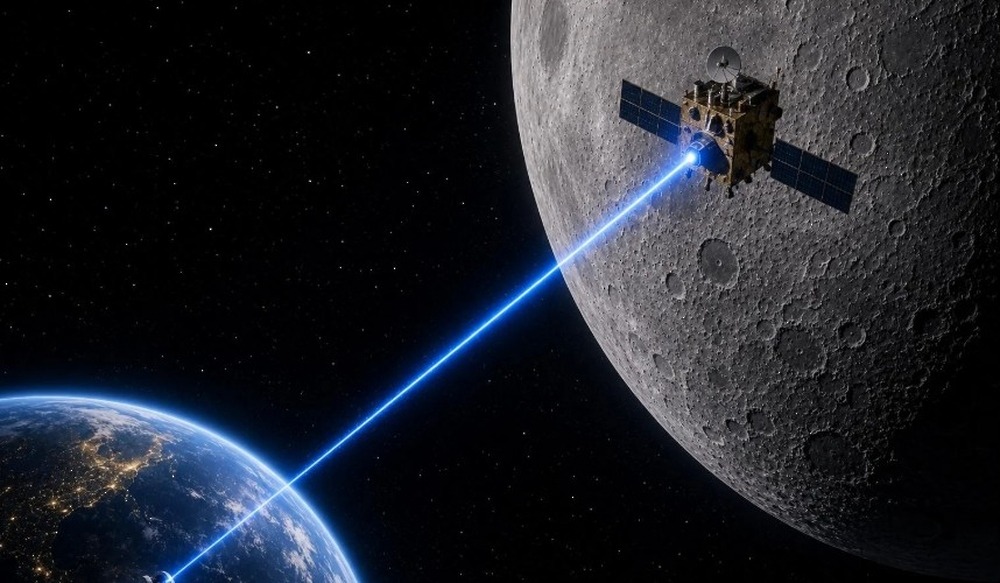

Beijing: The Technology and Engineering Center for Space Utilization under the Chinese Academy of Sciences said the achievement followed more than a year of in-orbit testing. The experiment successfully verified two-way high-speed laser communication and marks China’s expansion of space laser communications from near-Earth orbit into deep space.
During the test, researchers achieved an uplink communication speed of 1.25 Mbps and a downlink speed of 100 Mbps. At that speed, an 8K high-definition image of the lunar surface could reportedly be transmitted in around 12 seconds, compared with four to five minutes using a conventional 5 Mbps microwave link.
Laser communication offers several advantages over traditional microwave systems, including faster transmission speeds, greater bandwidth, stronger security and smaller, lighter equipment.
Read More
- IndiGo cancels Riyadh flights until October 31, 3 other Saudi routes until October 27 amid evolving security situation
- UAE closes all beaches in Umm Al Quwain after tanker oil spill detected
- Earthquake of Magnitude 7.0 Strikes Tibet; 16 Dead, 32 injured
- Nigeria reports first imported Ebola Bundibugyo case in Abuja: WHO
- US midterm voting begins in Texas as Democrats target historic gains
However, establishing such a link across the vast Earth-Moon distance presented three major technical challenges: accurately aligning the laser beam, detecting extremely weak signals and maintaining high data-transmission speeds.
Researchers developed new tracking and alignment techniques to compensate for satellite movement, atmospheric disturbances and other factors. Highly sensitive single-photon detection technology was also used to identify extremely weak laser signals amid interference from moonlight, starlight and city lights.
The breakthrough could become increasingly important as China advances plans for crewed lunar missions and the development of a lunar research station.
Future Moon exploration missions are expected to generate huge volumes of high-resolution images and scientific data, placing growing pressure on traditional communication bandwidth.
Scientists say the newly demonstrated Earth-Moon laser “information highway” could provide a faster route for transmitting such data and support future crewed lunar exploration, research stations and other deep-space missions.





