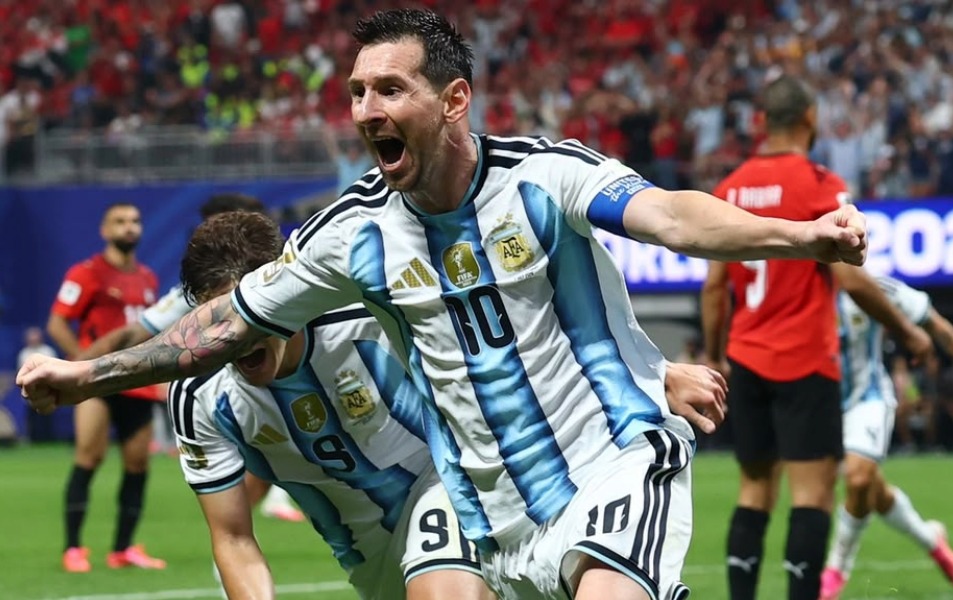
For nearly two decades, football has bent itself around Lionel Messi.
Generations have grown up believing the impossible was merely another Sunday afternoon. Defenders learned that chasing shadows was futile. Goalkeepers became spectators. Stadiums fell silent for a heartbeat before erupting into disbelief. The game found new ways to describe genius, and still ran out of words.
This, then, is the final chapter.
Read More
- Liverpool fight back from two goals down to beat Villarreal 4-3 in Champions League thriller
- Arshdeep Singh just five wickets away from becoming first Indian with 150 T20I scalps
- Schedule unveiled for ICC Women’s U19 T20 World Cup 2027
- Boland shines as South Africa struggle against Australia
- Portuguese FA suspends Cristiano Ronaldo for 30 days, imposes €255 fine
The 2026 World Cup is not simply another tournament for Messi. It is the closing act of the greatest international career football has witnessed. There will be no next cycle, no four-year wait, no sequel. Whatever happens over these ninety-minute battles will become the last images the world keeps of football’s most extraordinary artist.
He has already completed the sport’s grandest quest.
He conquered the Copa América. He climbed to the summit in Qatar in 2022, lifting the one trophy that had eluded him and ending one of football’s longest debates. Everything since has felt like an epilogue written by a champion who refused to leave the stage while he could still dance.
Yet greatness has never been measured only by medals.
Messi’s legacy lies in the beauty he restored to football. In an era obsessed with speed, power and systems, he reminded the world that imagination could still decide matches. He played as though the ball belonged to him alone, gliding through defenders with the serenity of a man solving a puzzle no one else could see.
Now, at 39, the bursts are shorter. The legs tire sooner. But the mind remains untouched. The vision still arrives before everyone else has recognised the possibility. Time has taken little from the footballer who has spent a lifetime making time stand still.
Every touch in this tournament will carry a sense of history. Every free-kick, every disguised pass, every slow walk from the tunnel will be viewed through the lens of farewell. The world is no longer watching simply to see whether Argentina win again. It is watching because one of football’s defining figures is taking his final bow.
Perhaps there will be another trophy. Perhaps there will not.
It scarcely matters.
The medals are already secure. The records will eventually be surpassed. But the feeling Messi created whenever he received the ball—that quiet certainty that something extraordinary might happen—belongs only to him.
When the final whistle sounds on Argentina’s last match of this World Cup, an era will end. Football will continue, as it always does. New stars will emerge. New champions will rise.
But there will never be another Lionel Messi.
This is one last dance.
And the beautiful game should savour every step.





