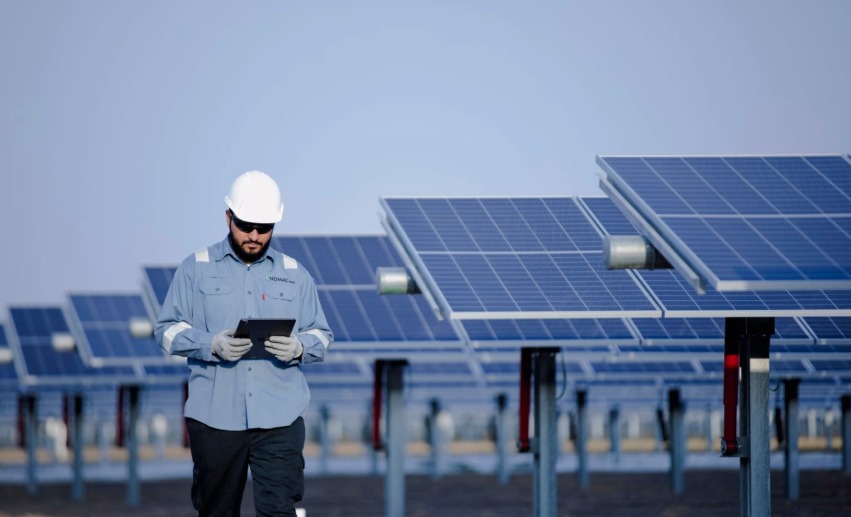

MUSCAT : The renewable energy sector in Oman has witnessed rapid growth in recent years with several large-scale projects already in operation. These include the Ibri (2) solar project, Manah (1) and Manah (2) solar energy projects, and the Dhofar (1) wind energy station. Together, these projects have a total production capacity of approximately 1,550 megawatts, contributing about 9.26 percent of the Sultanate’s total electricity production and strengthening the reliability of the national power grid.
Further expansion is already underway. Construction is progressing on the Ibri (3) solar project, which will include 100 MW battery electricity storage to enhance grid flexibility and support growing renewable capacity. The project is expected to begin operations in the second quarter of 2027. Meanwhile, the Dhofar (2) and Jaalan Bani Bu Ali wind energy projects are also under development and are anticipated to become operational in the third quarter of 2027.
Looking ahead, Oman has outlined an ambitious pipeline of renewable energy projects planned through 2030. These include solar energy projects in Al Kamil and Al Wafi, Sinaw, and the Marsa project, along with wind energy developments in Duqm (2) and (3), Mahout, Sadah, Shalim, the Hallaniyat Islands, and Al Jazir. The planned projects are expected to deliver a combined capacity of about 5,080 MW from solar energy and 1,720 MW from wind energy. In addition, a waste-to-energy project in Barka is scheduled to begin operations in the second quarter of 2031.
Read More
- Oman Chamber of Commerce and Industry elections set for November 23
- What did His Majesty Sultan Haitham and UAE’s Sheikh Tahnoun discuss during Muscat meeting?
- Oman Investment Authority invests in Spanish space company PLD Space
- Oman health facilities rise to 2,464 as sector expands in 2025
- Over 800 expired perfume and incense packages seized in Oman’s South Al Sharqiyah
The projects span several strategic locations across the Sultanate, including Dhofar, Al Wusta, North and South Al Batinah, North Al Sharqiyah, Al Dhahirah, and Al Dakhiliyah, covering renewable energy development zones estimated at around 65,000 square kilometres.
Through these initiatives, Oman aims to significantly increase renewable energy’s contribution to the national electricity mix, from 30–40 percent by 2030, to 60–70 percent by 2040, and eventually 90–100 percent by 2050.
Engineer Hamoud bin Hamad Al-Sawafi, Director General of Renewable Energy at the Ministry of Energy and Minerals, said renewable energy projects are a fundamental pillar in strengthening national energy security and supporting the transition to a sustainable economy in line with the objectives of Oman Vision 2040.
In a statement to the Oman News Agency, Al-Sawafi noted that the share of renewable energy connected to the national grid rose from 4.26 percent in 2024 to 9.46 percent in 2025, representing an increase of 5.2 percent in a single year. During 2025, renewable sources generated more than four million megawatt-hours of electricity.
He added that renewable energy projects have brought about a qualitative leap in the electricity sector by enhancing grid reliability, diversifying energy sources, strengthening national capabilities, and supporting the localization of solar and wind energy industries.
Environmental indicators also highlight the growing impact of these projects. Renewable energy initiatives currently help avoid approximately 1.62 million tonnes of carbon dioxide equivalent emissions from the electricity sector. By 2030, avoided emissions are expected to reach around nine million tonnes, including two million tonnes from wind energy projects and seven million tonnes from solar power.
Additionally, these projects help avoid the burning of about 1.5 billion cubic metres of natural gas, contributing to reduced emission intensity in the electricity sector and supporting Oman’s commitment to achieving net-zero emissions by 2050.
In terms of economic impact, renewable energy projects developed by Nama Power and Water Procurement Company have achieved local added value rates between 15 percent and 22 percent, with upcoming projects targeting more than 25 percent, equivalent to around RO 25 million. Approximately RO 5.7 million have also been directed to the local market to support small and medium enterprises.
Meanwhile, OQ Alternative Energy continues to expand its renewable energy portfolio, adding more than 2,000 MW of renewable capacity in 2025 through new power purchase agreements exceeding 740 MW. Key projects include Ibri (3) solar power and the Dhofar (2) and Jaalan Bani Bu Ali wind projects.
The company has also reported strong local value contributions, reaching 23.85 percent in the North Oman Solar Project, 14.75 percent in the Wind (1) project, and 18.50 percent in the Wind (2) project, reinforcing its commitment to strengthening national supply chains and local industry participation.
In addition, OQ launched the country’s first national energy efficiency platform, which achieved annual savings of 22.5 gigawatt-hours of electricity and reduced carbon emissions by around 9,400 tonnes.
Construction is also progressing on the Wind 1 and Wind 2 projects, with a combined capacity of 234 MW across 36 turbines, making it the largest wind farm currently under development in Oman. The project has already recorded more than one million safe working hours and is expected to enter commercial operation in 2026.
Meanwhile, the 128 MW North Oman Solar Power Project is also advancing steadily, further reinforcing OQ Alternative Energy’s role in driving the country’s energy transition.
For all the latest news from Oman and GCC, follow us on Twitter, Instagram and LinkedIn, like us on Facebook and subscribe to our YouTube page, which is updated daily.





