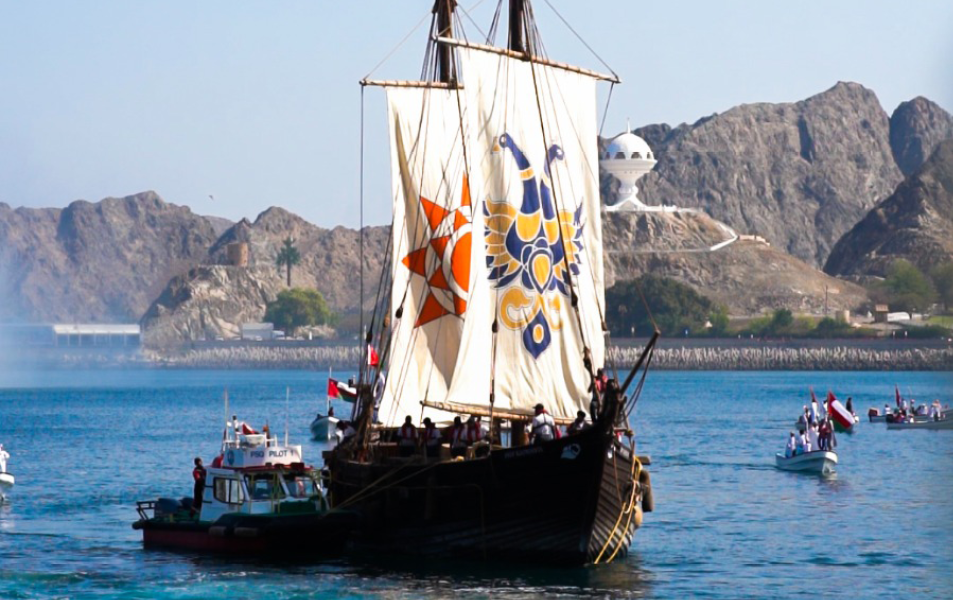

Muscat: The vessel had arrived in Muscat on January 14 after setting sail from Porbandar in the western Indian state of Gujarat on December 29. The expedition symbolised the deep-rooted maritime, cultural and civilisational links between the two nations, spanning over 5,000 years, while underscoring the idea that oceans serve as connective corridors rather than barriers.
Sanjeev Sanyal, a member of the Economic Advisory Council to the Prime Minister of India and the person who originally pitched the idea of building a stitched ship, said that while he has returned to India, seventeen crew members remain on board for the homeward voyage. He described the journey as a living tribute to the shared seafaring heritage of the Indian Ocean world.
The voyage holds added significance as India and Oman mark 70 years of diplomatic relations. Upon its arrival in Muscat, the vessel received an official welcome at the port on January 14, featuring cultural programmes by students from various Indian schools. Azzan Al Busaidi, Undersecretary at the Ministry of Heritage and Tourism, attended the ceremony as chief guest.
Read More
- Oman extends condolences to Pakistan after Islamabad hospital fire
- GCC history forum participants thank His Majesty Sultan Haitham for Oman’s warm hospitality
- His Majesty Sultan Haitham sends condolences to Nepal president over flood, landslide victims
- Oman records highest temperature of 46.2°C
- Heavy rain and hail lash Oman’s Al Buraimi, triggering wadi flows
The modern-day voyage of Kaundinya draws inspiration from the legendary sea crossings associated with the historical figure Kaundinya, dated to around the 1st century CE. These journeys formed part of a vast Indian Ocean maritime network in which the western coast of India and the Omani-Arab seaboard played a pivotal role.
By this period, Oman’s ports, notably Muscat, Sohar and Sur, were already integral hubs in Indian Ocean trade. Omani and Arab sailors were renowned for their mastery of monsoon-driven navigation, knowledge that was shared with Indian mariners from Gujarat, Konkan, Kerala and the Coromandel Coast. Ships similar to Kaundinya relied on these seasonal winds to undertake long-distance voyages across the Arabian Sea and the Bay of Bengal.
Captain Saleh Said Al Jabri, Captain of the Jewel of Muscat, said the arrival of INSV Kaundinya vividly recreated the historical ties that have linked Oman and India for thousands of years. He noted that traditional sailing ships navigating by monsoon winds played a crucial role in fostering commercial and social connections between the two regions.
Commander Visas Sheoran, Skipper of INSV Kaundinya, said the voyage from India to Oman took 17 days. He added that the vessel remained in Oman for 20 days to undergo necessary maintenance work before commencing its return journey.





