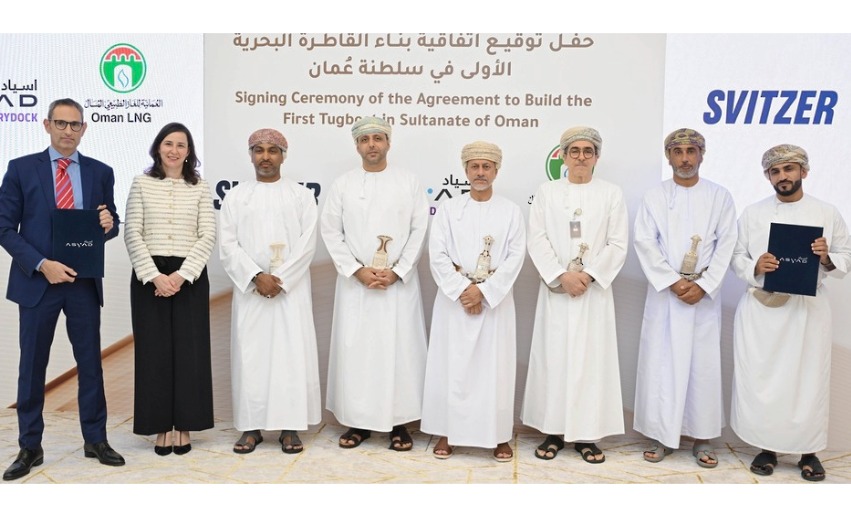

MUSCAT – The project is a key milestone for Oman’s maritime industry, strengthening national industrial and maritime capabilities by localizing high-value marine assets.
The signing ceremony was held under the patronage of His Excellency Abdulsalam Mohammed Al Murshidi, Chairman of Oman Investment Authority (OIA).
The ceremony was attended by Hamed Mohammed Al Numani, CEO of Oman LNG; Ahmed bin Ali Al Balushi, CEO of Asyad Drydock and Infrastructure Services at Asyad Group; and Karim Cordahi, Executive Director for the Middle East and North Africa at Svitzer.
This project builds on the long-standing partnership between Oman LNG and Asyad Group, based on shared roles across Oman’s energy, logistics and maritime ecosystem. It takes this partnership beyond operational, marine and logistics services into a more advanced phase of industrial collaboration. The project also reflects Oman LNG’s focus on In-Country Value and the technical capabilities of Asyad Drydock.
On this occasion, His Excellency Al Murshidi commented: “This project signifies a pivotal new phase of integration within our national investment ecosystem. It underscores our strategic imperative to localize the construction and execution of strategic assets in Oman. The selection of Asyad Drydock for this critical marine asset is a testament to the advanced state of the national industrial capabilities. Furthermore, it demonstrates the profound confidence our national companies place in local platforms to deliver high-value assets that meet the most exacting international standards. This initiative is in direct alignment with OIA’s mandate to channel investments into sustainable industrial ecosystems that enhance in-country value and foster the long-term, robust growth of our national economy.”
On his turn, Hamed Mohammed Al Nu’amani, CEO of Oman LNG, said: “From the start, Oman LNG was clear that building the tugboat locally, supported by Asyad Group’s investment, should go beyond delivering an operational asset. It should strengthen our country’s maritime legacy and connect it to our business. That is why Asyad has always been our strongest partner. By making local construction a core contractual requirement, we ensured the project contributes directly to national capability building and knowledge transfer. It also supports future growth linked to the marine and shipbuilding industries. This is fully aligned with our firm commitment to In-Country Value.”
He added that this project underscores the increasing confidence placed in Asyad Drydock’s profound technical expertise, state-of-the-art infrastructure, and highly qualified national talents. It serves as a powerful demonstration of the company’s capability to execute complex ship repair, shipbuilding, and major marine engineering projects in Oman, consistently adhering to the highest international standards.
For his part, Ahmed Ali Al Balushi, CEO of Asyad Drydock and Infrastructure Services at Asyad Group, stated: “Asyad Drydock serves as a national industrial platform for localizing the construction of high-value marine assets in Oman. We are guided by a sustainable approach aimed at maximizing local content. Th project is planned to achieve 50 percent local content. In 2025, our total local expenditure reached approximately RO 46 million, of which RO 7.777 million was directed to local SMEs. This underscores our unwavering commitment to empowering national businesses and strengthening local industrial capabilities.”
This initiative, he affirmed, also reflects Oman LNG’s approach to turning In-Country Value commitments into measurable results. It does so by embedding ICV into contracts and operating models to maximize local economic impact and generate jobs, as Omanisation among service and business partners has exceeded 85%. In addition, 79 percent of total supply chain spending has been directed to locally registered companies.
Read More
- Oman’s local liquidity exceeds RO 28.6 billion by end of May 2026
- Qiddiya launches ‘Powered by Play’ as study finds Saudis lead global belief in Play’s benefits
- Oman’s Ibri Industrial City attracts RO25 million in investments by mid-2026
- Oman’s natural gas production rises 6.7% in first half of 2026
- China’s EV boom cuts fossil fuel use; oil displaced rises 42% in H1 2026: Jefferies





