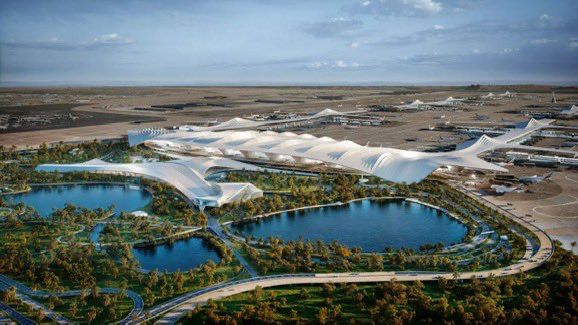

DUBAI : The futuristic idea is part of Dubai’s grand $35 billion expansion of Al Maktoum International Airport (DWC), which aims to redefine how the world travels by 2032.
Paul Griffiths, CEO of Dubai Airports, revealed to Flight Global that Dubai’s new mega-airport may integrate with the upcoming Etihad Rail network, allowing passengers to drop off their bags at train stations en route to the terminal. The initiative, he said, would streamline travel and tackle one of the airport’s key challenges, the lack of a direct metro link. The closest station currently sits 5km away at Expo.
The planned Etihad Rail network will feature a high-speed passenger line connecting Abu Dhabi and Dubai, with six stations across key locations including Reem Island, Saadiyat Island, Yas Island, Zayed International Airport, near Al Maktoum International Airport, and Al Jaddaf in Dubai.
Read More
- Tourists evacuated from China’s Jiuzhaigou park after mudslides
- UN warns funding shortfall threatens nutrition programmes for 5.7 million in Afghanistan
- Typhoon Noul hits southern China, forcing evacuation of over 340,000 people
- 32 civilians killed in armed attacks in eastern DR Congo
- Pralhad Joshi appointed as India’s new education minister after Pradhan quits amid NEET protests
Unveiled in April 2024, the $35 billion expansion of Al Maktoum International is one of the largest aviation projects in the world. Once complete, the airport will boast five runways, 400 gates, and a staggering capacity of 260 million passengers a year, up from the current 100 million. The facility is expected to be ready by 2032.
With Dubai International (DXB) nearing capacity, passenger numbers are expected to reach 99 million next year and 115 million by 2031, the new airport will become the city’s main aviation hub. Emirates and flydubai, which currently handle two-thirds of DXB’s traffic, are slated to move all operations to Al Maktoum International, which is projected to serve 124 million passengers in its first year.
Griffiths emphasized that technology will be central to the airport’s design, describing it as a “frictionless airport” where biometric systems replace traditional check-ins and security processes. “You simply show up and walk through discreet but effective security,” he said. “Cameras are embedded in walls and gathering data.”
Unlike conventional mega-terminals, Al Maktoum International will be divided into eight zones, each capable of handling 30 million passengers annually, creating a more efficient, human-centered airport experience that redefines the future of global travel.
For all the latest news from Oman and GCC, follow us on Twitter, Instagram and LinkedIn, like us on Facebook and subscribe to our YouTube page, which is updated daily.





