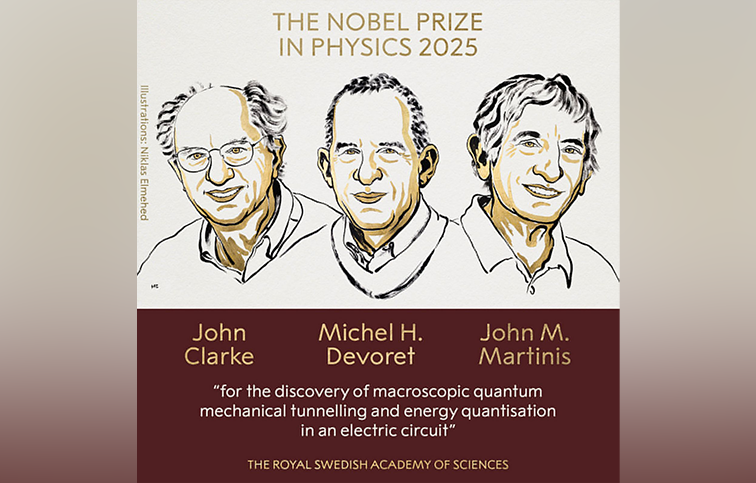

STOCKHOLM : The Royal Swedish Academy of Sciences has awarded the 2025 Nobel Prize in Physics jointly to John Clarke, Michel H. Devoret, and John M. Martinis for their “discovery of macroscopic quantum mechanical tunnelling and energy quantisation in an electric circuit.”
The trio’s pioneering work bridged the gap between classical and quantum physics, demonstrating how quantum phenomena—once thought observable only at the atomic scale—can manifest in larger, engineered systems such as superconducting circuits.
Their discoveries laid the foundation for superconducting quantum bits (qubits), which today form the backbone of many quantum computers under development around the world.
Read More
- “Another milestone in India’s space journey”: MEA congratulates ISRO on GSLV-F18 launch
- Air India gets DGCA approval for flying academy in Maharashtra
- Nine dead, five injured after oxygen cylinder explodes inside ambulance in Pakistan
- Cyclone Arnab kills three in eastern India
- Thousands evacuated as Cyclone Arnab approaches India’s eastern coast
According to the Nobel Committee, the laureates’ contributions “redefined our understanding of how quantum mechanics governs the macroscopic world, opening pathways for revolutionary advances in computation, sensing, and information processing.”
The Nobel Prize in Physics, one of the most prestigious honours in science, comes with a gold medal and 11 million Swedish kronor (approximately USD 1 million), to be shared equally among the winners.
For all the latest news from Oman and GCC, follow us on Twitter, Instagram and LinkedIn, like us on Facebook and subscribe to our YouTube page, which is updated daily.