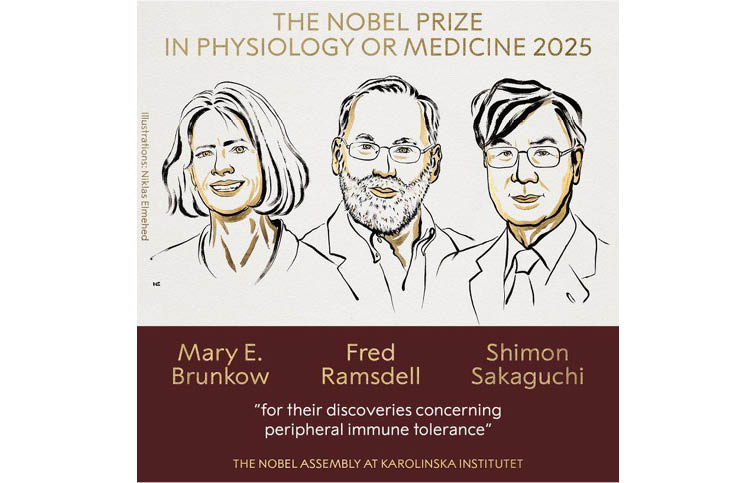

Stockholm — The 2025 Nobel Prize in Physiology or Medicine has been jointly awarded to Mary E. Brunkow, Fred Ramsdell and Shimon Sakaguchi for their pioneering discoveries that transformed understanding of the human immune system — specifically, the mechanisms behind peripheral immune tolerance.
Announcing the award on Monday, the Nobel Assembly at Karolinska Institutet cited the trio’s seminal work in uncovering how the immune system learns to distinguish between self and non-self, thereby preventing autoimmune diseases. Their discoveries laid the foundation for new therapies in immunology, cancer, and organ transplantation.
Brunkow and Ramsdell, both American researchers, and Sakaguchi, from Japan, identified and characterized regulatory T cells (Tregs) and key genetic pathways that maintain immune balance. Their collective work, spanning over two decades, has provided vital insights into diseases such as type 1 diabetes, multiple sclerosis, and rheumatoid arthritis — where the immune system mistakenly attacks the body’s own tissues.
Read More
- Russia charges Telegram founder Pavel Durov with ‘facilitating terrorism’, issues international arrest warrant
- Meta, BlackRock partner to build USD 14 billion Texas data center campus
- India at UNSC says “world’s focus on Strait of Hormuz” must not divert attention from Gaza
- Many trapped in damaged shopping mall after major 7.1-magnitude Japan earthquake
- Over 390,000 customers lose power as tornado tears through northeast Wisconsin
“Their findings have profoundly shaped modern immunotherapy,” the Nobel Committee said, noting that the concept of immune tolerance has become a cornerstone in medical science, influencing vaccine development and precision medicine.
The Nobel Prize in Physiology or Medicine carries a prize of 11 million Swedish kronor (approximately USD 1 million), to be shared equally among the laureates.





