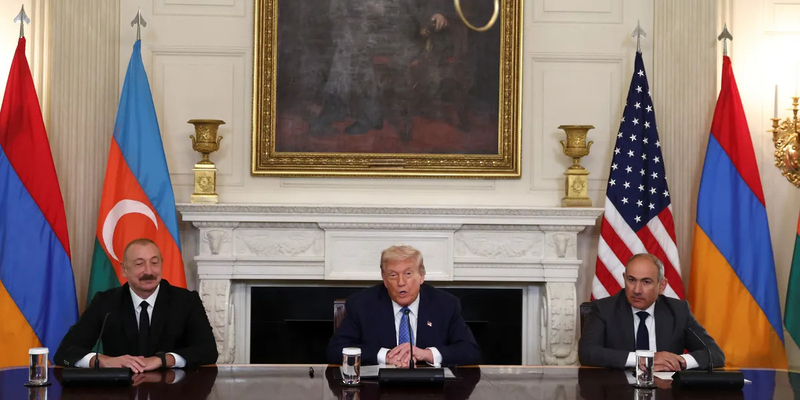

WASHINGTON – The breakthrough was achieved during a summit hosted by U.S. President Donald Trump at the White House, where Azerbaijani President Ilham Aliyev and Armenian Prime Minister Nikol Pashinyan signed a landmark agreement referred to by the White House as a “Joint Declaration.”
The document includes provisions for the creation of a “transit zone” through Armenian territory to connect mainland Azerbaijan with its western exclave, Nakhchivan.
Both leaders hailed the agreement as a turning point. “Today we establish peace in the Caucasus,” President Aliyev declared, while Prime Minister Pashinyan called the accord “a historic day” and “a path toward ending decades of hostility.”
Read More
- Germany records nearly 10,000 heat-related deaths this year
- US military completes two-hour strikes on dozens of IRGC targets in Iran
- Russia charges Telegram founder Pavel Durov with ‘facilitating terrorism’, issues international arrest warrant
- Meta, BlackRock partner to build USD 14 billion Texas data center campus
- India at UNSC says “world’s focus on Strait of Hormuz” must not divert attention from Gaza
Baku and Yerevan fought two wars over control of the Nagorno-Karabakh enclave, the first following the fall of the Soviet Union and the second in 2020, before Baku seized it in a 24-hour offensive in September 2023 that displaced more than 100,000 Armenians.
Following this, the two countries agreed to a comprehensive peace agreement last March. However, Azerbaijan subsequently made a number of demands before signing the document, particularly amendments to the Armenian constitution to remove any claim to the enclave. Pashinyan expressed his willingness to meet the demands, announcing his intention to hold a constitutional referendum in 2027.





