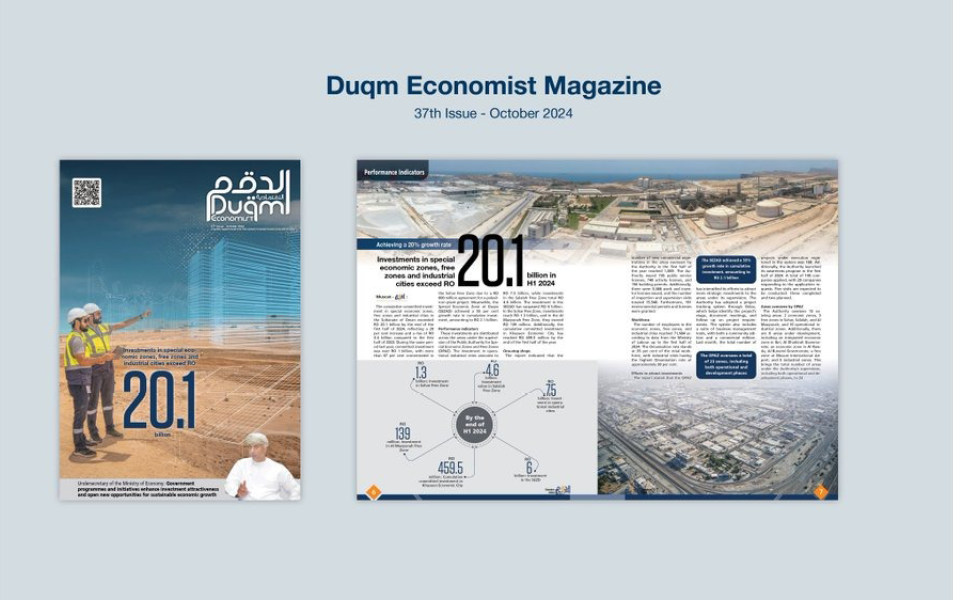

MUSCAT : This significant increase underscores the government’s commitment to enhancing the investment landscape as part of Oman Vision 2040.
As per the 37th issue of Duqm Economist Magazine, the cumulative committed investment in these sectors demonstrates a growth of RO 3.4 billion compared to the same period last year, showcasing the positive trajectory of Oman’s economy. Key areas contributing to this growth include the Special Economic Zone at Duqm (SEZAD), which achieved a remarkable 55 percent increase in cumulative investment, reaching RO 2.1 billion.
The latest edition of the Magazine sheds light on the remarkable progress achieved in Oman’s special economic zones, free zones, and industrial cities. The report highlights significant investments, positive indicators, and government initiatives that are driving economic growth and aligning with Oman Vision 2040.
According to the Undersecretary of the Ministry of Economy, government programs and initiatives are actively supporting investments, thereby enhancing the objectives of Oman Vision 2040.
The Public Authority for Special Economic Zones and Free Zones (OPAZ) manages a total of 23 zones, encompassing both operational and development phases. The cumulative committed investment across these zones includes:
- Sohar Free Zone: RO 1.3 billion
- Salalah Free Zone: RO 4.6 billion
- Al Mazyunah Free Zone: RO 139 million
- Khazaen Economic City: RO 459.5 million
- Special Economic Zone at Duqm (SEZAD): RO 6 billion
The magazine highlights that the cumulative investment in these sectors represents an increase of RO 3.4 billion compared to the same period last year. Notably, over 67 percent of last year’s committed investments were concentrated in the Sohar Free Zone, which benefitted from a RO 600 million agreement for a polysilicon plant project.
In the first half of 2024, the number of new commercial registrations in the areas overseen by OPAZ reached 1,885. The Authority issued 735 public service licenses, 740 activity licenses, and 156 building permits. Additionally, 5,466 work and investor licenses were granted, with a total of 15,548 inspections and supervision visits conducted.
The workforce in the economic zones, free zones, and industrial cities totalled 71,684, with an Omanisation rate of 35 percent. Industrial cities reported the highest Omanisation rate at approximately 38 percent.
To further attract strategic investments, OPAZ has implemented a project tracking system that monitors project stages and requirements. The system currently tracks 160 projects under execution. An awareness program launched by the Authority saw 145 companies apply, with 20 responding positively.
Currently, OPAZ oversees 15 existing areas: 2 economic zones, 3 free zones in Suhar, Salalah, and Al Mazyunah, and 10 operational industrial zones. Additionally, there are 8 areas under development, including an integrated economic zone in Ibri, Al Dhahirah Governorate; an economic zone in Al Rawda, Al Buraimi Governorate; a free zone at Muscat International Airport; and 5 industrial zones. This brings the total number of areas under the Authority’s supervision, including both operational and development phases, to 23.
For all the latest news from Oman and GCC, follow us on Twitter, Instagram and LinkedIn, like us on Facebook and subscribe to our YouTube page, which is updated daily.
Read More
- Alizz Islamic Bank awarded by World Union of Arab Banks ‘Best Transformation in Islamic Banking in Oman 2026’
- Omani Brand AMTUR Gold & Diamonds expands to Qatar with opening of 14th branch
- Development Bank Sustainability expert joins Duqm Summer Podcast Series
- Oman refinery output falls 3.7% to 129 million barrels
- GCC stock trading rises 19.5% as markets record $618 billion in deals





