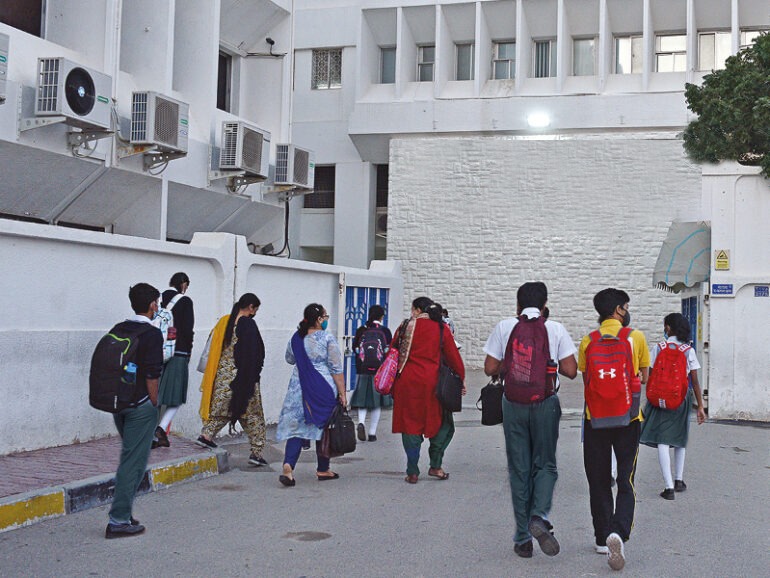

MUSCAT: Prompted by a parent’s concern about his child having to carry a schoolbag weighing up to 9 kilograms, filled with textbooks, notebooks, and writing materials, The Arabian Stories (TAS) picked up the cue to highlight the contentious issue of bags that keeps cropping up, year after year, without a clearcut solution.
To get to the bone of the issue, TAS spoke to representatives from the education sector to discern their mood following the onset of the new term in government schools.
While opinions tend to differ, there, undoubtedly, is a general consensus on the importance of ensuring student health by incorporating measures that do not physically tax them. The Ministry of Education has, in fact, taken significant steps to address the issue of heavy school bags, particularly for grades 1 to 4.
Read More
- Oman reviews response to oil tanker grounding off Qibliya Island
- India expands training opportunities for professionals in Oman through ITEC programme
- Oman approves over RO 100,000 to support 144 scientific research papers
- Oman and Bahrain strengthen cooperation against human trafficking
- Oman signs two green hydrogen deals, targets 121,000 tonnes annually by 2032
As one medical expert pointed out, carrying excessively heavy bags can lead to health problems such as back deformities, spinal issues, and bone sprains, as well as mental distractions and long-term academic challenges.
To combat these issues, the Ministry has enacted a new directive limiting first-cycle students to two 80-page notebooks – one for each subject – and banning the use of additional binders or booklets. Teachers are coordinating homework assignments to further alleviate the burden, and continuous monitoring will be conducted by educational specialists across the governorates.
Importantly, the Ministry has introduced lockers in schools to minimize the need for students to transport books daily and encourage the use of electronic textbooks through the educational portal.
However, the flip side to this is the concern raised by some parents on the increase in screen time. As one teacher from the Indian School Muscat told TAS: “Teachers have been encouraged to put up study material online, textbooks, pdf, videos, etc., to help the students out. But the other side of the coin is that these same parents then come back to us and tell us that we have increased the screen time for their kids. So, either way, there is an adverse effect.”
‘Children Are Not Weightlifters’
Underscoring the need to balance the scale on the schoolbag issue, Dr. Sivakumar Manickam, Chairman of the Indian School Board, states: “We must remember that children are not weightlifters, and school bags should not be mistaken for heavy cargo. The escalating weight of school bags and its detrimental impact on children’s health is a pressing concern for every parent.”
In response to a TAS query, Dr. Manickam raises an urgent concern about the physical toll of heavy school backpacks on students. Even in today’s era where technology has made life more comfortable, it is unfortunate to see schoolchildren carrying around heavy school backpacks, he notes.
Unlike in the past, most subjects are taught daily, requiring students to bring all their textbooks to and from school. This, he points out, can make children develop a forward head posture with the body hinging forward at the hips to balance out and compensate for the heavy weight on their backs, thus causing unnatural posture alignment. Experts recommend that backpack weight should be proportionate to a child’s size and weight.
Children spend 6–8 hours in school, carrying books, notebooks, lunch, water bottles, and sports gear in their bags. Poorly organized, these bags can become burdensome, causing headaches, muscle strain, and persistent back, neck, and shoulder pain.
To lighten this load, Dr. Siva calls on parents and schools to adopt practical strategies and even ‘bagless days’ as adopted by some institutions.
To reduce the burden of heavy school bags:
- Pack essentials only; leave unnecessary items at home.
- Schools can offer lockers or storage facilities.
- Opt for lightweight, durable bags with wide, padded straps.
- Teachers could coordinate assignments to reduce the number of books students need to carry.
- Leverage digital resources to reduce reliance on physical textbooks.
- Parents should regularly check their ward/s bags to clear unnecessary items.
- Schools can implement ‘bagless days’ as done by some educational institutions, whereby students engage in activities that do not require heavy materials.
“By setting clear guidelines, the critical issue of heavy school bags, which affects children’s physical development and academic performance, can be effectively addressed, paving the way for a more balanced and enjoyable learning experience,” he stresses.
Is the heavy schoolbag issue overblown? A teacher’s perspective
While acknowledging that heavy bags can cause physical strain and fatigue, a teacher from an Indian School notes that no child has stopped studying solely due to bag weight. “We are looking at a shorter span of time of them carrying their bags. Physically, it does put a load on them, but I haven’t seen a child whose long-term posture has been affected because of it,” she states.
In reply to a question if heavy schoolbag issue affects a child’s performance, she states: “I agree with the authorities who mentioned that the weight of the bag has led to fatigue, but I don’t think the weight of the bag directly correlates to the child’s un-attentiveness or study habits; that could be because of a lot of reasons. But then my counter question would be, ‘How many hours was the child carrying the heavy bag that it led to extreme fatigue, which affected the child’s studies?’”
To the query if overprotectiveness from parents is triggering the issue, she points out that this is no fault of the child. “It’s the parents who create that cloud for the child. The child is caged within that cloud and is not mature enough to know what is happening. Nowadays, parents think that their child is the best, irrespective of what the child does, to protect the child from any mental trauma.
“Earlier in my days, school was not just meant for academics, nor was society meant to be pampered. The school was a place where the children were taught to survive, which is what we call the holistic development of the child. If the parent is protective, the child will take a back seat. In the older days, the child stood up for themselves without adult interference. Because parents are stepping in for them, the child remains a child even in adulthood. As teachers, we feel that children should be allowed to grow in their circumstances. Now we are trying to play the safe game by saying good job no matter what without having any scope for improvement,” she adds.
According to her, one of the reasons for heavy backpacks is the indifference among some students to check their timetables, despite concerted efforts to ensure the number of books are reduced. “They bring every book so that they don’t get into trouble,” she opines, noting that even parents end up not checking on their child’s timetable.
“Only when the child mentions a backache, do they check,” she indicates, stressing that teachers tend to inform students which books to bring. Besides, the school portal also has uploaded PDFs to help students in the absence of a textbook, she states, pointing out that the practice has been followed since the time of pandemic.
However, as she notes, one potential drawback of using online resources is that students may be distracted and engage in activities other than studying. Additionally, some parents may not have resources to provide their children with the necessary devices for accessing online portals, especially in schools that follow a ‘Bring Your Own Device’ policy.
Another issue of contention is the trolley bag. Although children are asked not to bring those to schools, they tend to carry them, which, again, adds to the weigh. “We may not have locker facilities yet, because of the lack of infrastructure, but we do have classrooms for storing books, and children are encouraged to leave their books there,” she explains.
While the debate continues, there is no doubt that the issue of heavy school bags is a pressing concern that requires attention from parents, schools, and policymakers. The time is now to implement effective strategies and promote a balanced approach to education, to ensure that children’s physical and mental well-being is not compromised by the weight of their backpacks.





