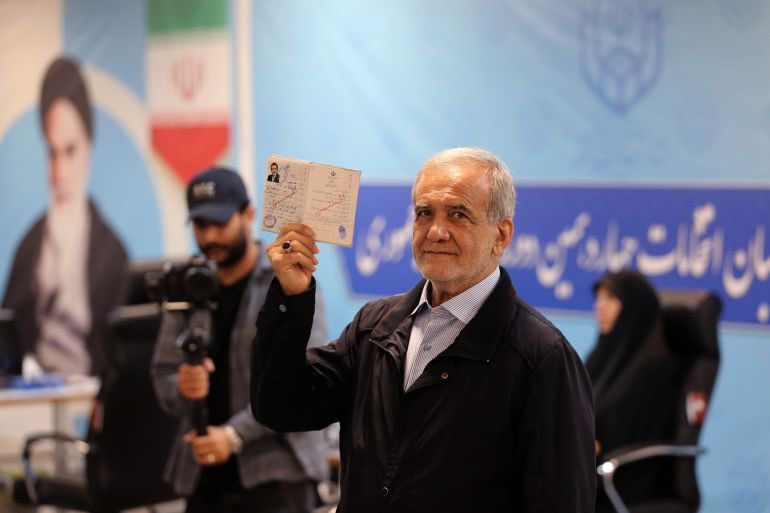

IRAN: Iran’s presidential election has become a nail-biting contest between reformist Masoud Pezeshkian and hard-liner Saeed Jalili, with seesawing results reported early Saturday. Iranian state television announced that neither candidate currently holds a decisive lead, hinting at a potential runoff to determine the successor to the late hard-line President Ebrahim Raisi.
As of now, Pezeshkian has garnered 8.3 million votes, closely followed by Jalili, with 7.18 million out of the over 19 million votes counted. Hard-line parliament speaker Mohammad Bagher Qalibaf trails with 2.67 million votes, while Shiite cleric Mostafa Pourmohammadi has secured over 158,000 votes.
Voters faced a choice between three hard-line candidates and the relatively unknown reformist Pezeshkian, a heart surgeon. The election, devoid of international oversight, continues Iran’s tradition since the 1979 Islamic Revolution of excluding women and advocates of radical change from running. The results so far have not included voter turnout figures, a crucial indicator of public support for Iran’s Shiite theocracy amid economic turmoil and recent mass protests.
Read More
- Philippines, GCC move to expand medical screening network for workers heading to Gulf
- Air India appoints former Ethiopian Airlines Chief Tewolde Gebremariam as new CEO, MD
- GCC bottled water market reaches $7.55 billion
- Lightning strikes kill 14 people in India’s Jharkhand
- Libyan coast guard rescues 29 migrants off Sirte coast
The election unfolds against the backdrop of heightened tensions in the Middle East, particularly the ongoing Israel-Hamas conflict in Gaza. In April, Iran launched its first-ever direct attack on Israel over the war, while Iran-backed militia groups, including Hezbollah and Yemen’s Houthi rebels, have intensified their attacks.
Iran remains a focal point of international scrutiny as it continues to enrich uranium at near weapons-grade levels, maintaining a stockpile large enough to potentially build several nuclear weapons. Calls for an election boycott have come from figures like imprisoned Nobel Peace Prize laureate Narges Mohammadi and Mir Hossein Mousavi, a leader of the 2009 Green Movement protests.
To win outright, a candidate must secure over 50% of the votes. If this threshold isn’t met, the top two candidates will proceed to a runoff, marking only the second time in Iran’s history this has happened since the 2005 election. The recent election period has seen limited violence, with one attack reported in Sistan and Baluchestan province, resulting in the deaths of two police officers.





