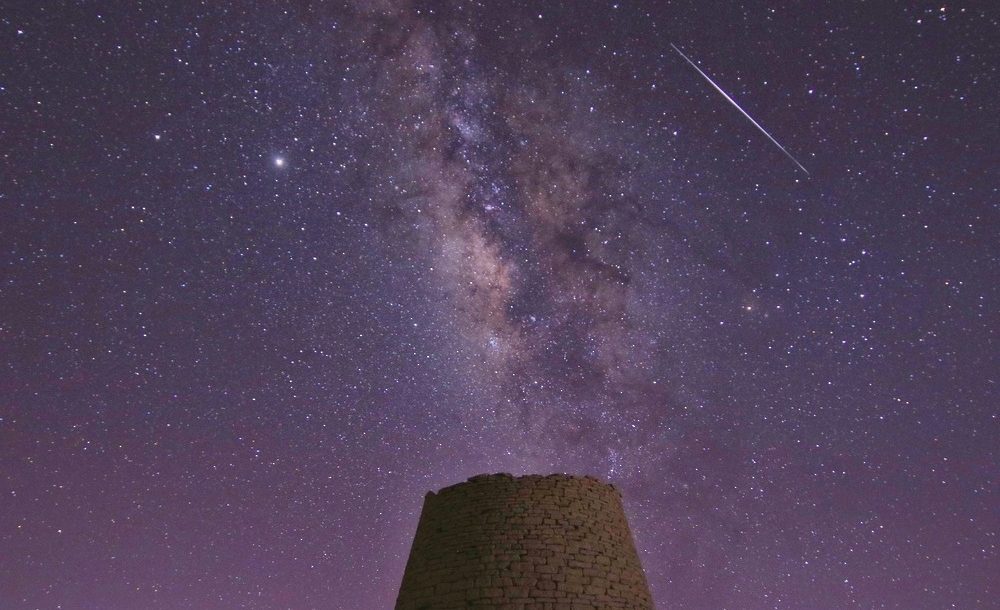

Muscat – The display will peak on Wednesday night and the dawn of Thursday, December 13 and 14.
Ibrahim bin Mohammed Al Mahrouqi, Vice Chairman of the Board of Directors of the Oman Astronomical Society, told the Oman News Agency that the month of December will witness a number of astronomical events, including the fall of meteor showers known astronomically as Geminis.
He added that these meteors are one of the best throughout the year, as they fall on a dark night devoid of moonlight at almost all hours of the night.
He stated that astronomical calculations indicate that this meteor shower will reach its peak on Wednesday evening and continue until Thursday dawn, as meteors and fireballs can be seen in the skies of the Sultanate and the world in an eye-catching scene.
It is expected that its fall rates will reach 120 meteors per hour – in 2020 members of the Omani Astronomical Society monitored 1,063 meteors, the result of 6 hours of monitoring the Geminid meteor shower in an eye-catching scene. Its peak was between 1:00 and 1:59, reaching 227 meteors during one hour.
He explained that the Geminid meteor shower results from the debris of the asteroid known as ‘Phaethon’, which was discovered in 1982 – unlike the rest of the meteors that come from comets.
Al Mahrouqi pointed out that the debris of this asteroid enters the Earth’s atmosphere every year from December 7 to 17, and this causes the phenomenon of meteors that are characterized by their many colors, indicating that when the Earth’s orbit directly intersects with those remains, the latter burns at the top of the Earth’s atmosphere at a speed of about 35 degrees kilometers per second at an altitude of approximately 70 to 100 kilometers, in the form of bright meteors, which are relatively slow compared to other meteors, resulting in the formation of wonderful long arcs that appear in yellow, green, or blue, and last for a second or two in the sky.
“In addition to the Geminid meteors, bright stars are observed in the night sky and can be seen with the naked eye, such as Leo’s Heart, Sirius, Aldebaran, Orion, the stars of Gemini, the stars of Taurus, and the Pleiades cluster, and some planets can be seen with different colors and varying brightness, such as Jupiter, which is the giant of the planets, but it appears smaller than Venus because of its distance,” he explained.
Regarding the possibility of observing the phenomenon, Al Mahrouqi says: “The observation must be from a dark location, far from sources of light pollution or any obstacle such as tall trees, and one must look towards the eastern horizon of the sky’s dome from after midnight on Wednesday until before dawn on Thursday.”
He explained that this is considered one of the astronomical phenomena that can be viewed with the naked eye without the need to use special monitoring devices.
Read More
- Oman rolls out diesel subsidy cards from Dec. 1, keeps rate at 258 baisa a litre
- His Majesty Sultan Haitham sends letter to Pakistan PM Shehbaz Sharif
- Oman draws up licensing rules for IT firms as regulator’s remit expands
- Oman sets fines of up to OMR 30,000 under new rules on promotional calls and texts
- Oman, Japan stress maritime security in Tokyo talks