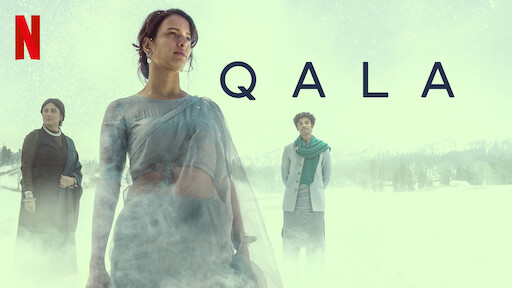

Qala
(Available on Netflix)
Qala, Anvita Dutt Guptan’s second directorial venture with Netflix, paints a beautiful yet melancholic picture against the backdrop of Indian classical music and the snowy Himalayas. The film revolves around Qala, a daughter of a celebrated classical singer, whose only goal in life was to attain recognition, especially from her mother. At the core of the film lies this mother-daughter story of disappointment and anguish, brought to life beautifully with the performances of Swastika Mukherjee and Tripti Dimri. The mother wanted her daughter to surpass the talents of her father and wanted to make her an ustaad (a master)of Indian classical music. However, it is soon established that her voice was nothing to write home about and simply did not possess the aptitude necessary to fulfill her mother’s dream. Qala soon becomes the object of her mother’s disappointment and open frustration, and soon finds herself replaced from her favor by a village prodigy, Jagan (played by Babil Khan). Jagan soon becomes her mother’s obsession, not only because of his talent but also because she sees her unborn son in him. But at the foreground of the film is a gradually disappearing Qala, who finds herself at a loss of identity and recognition, a girl who cannot fathom her place in the world. The film follows the events of her life as she struggles to fulfill her fierce struggle for recognition, with the thirst for her mother’s love at its epicenter.
Read More
- Superstar Rajinikanth’s ‘Jailer 2’ sets Oman cinemas on fire with over 20 shows a day
- Veteran Indian actor Nana Patekar dies at 75
- Ayushmann Khurrana and Sara Ali Khan bring the energy to Chandigarh ahead of Udta Teer
- One Feeling at a Time: Talwiinder begins his ‘Paiinted Feeliings’ journey with ‘Assay Passay’
- Avengers: Endgame Encore opens in Oman as Kuwait cancels cinema release
Tied together with beautiful performances, Qala does not feature a star cast, but a powerful one. But perhaps what viewers will take to their hearts is how the visuals of the film complement the story. With a Wes Anderson-esque color palette on a visually breathtaking backdrop, the film establishes the tasteful grandiose of classical music. Featuring visual references to the styles of Ingmar Bergman, Stanley Kubrick, and Alfred Hitchcock, Qala can be considered an ode to an era captivated by cinema. What is perhaps the most remarkable feature of the film is the usage of silence, which is ironic, given that Qala had every opportunity to be a musical. In fact, Qala can be seen as a study of silence and subtlety in the film medium, something film buffs may have seen time and again in the works of Andrei Tarkovsky. Although some scenes do leave much to be desired, overall, Qala does justice to the story it sets out to tell.





