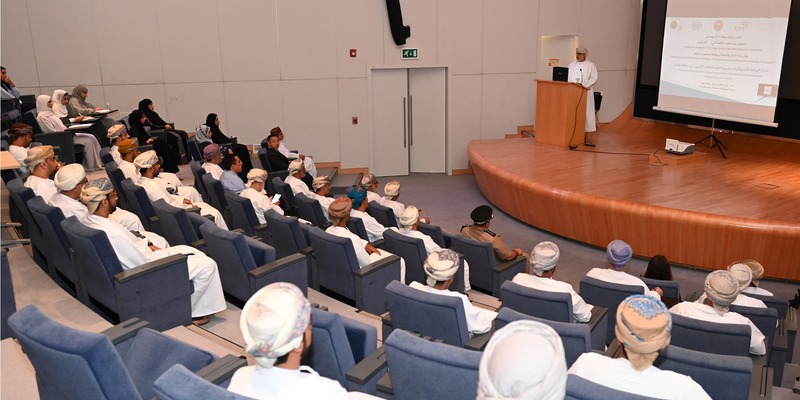

MUSCAT : The workshop on preparing a low-carbon transport strategy – organized by the Environment Authority, in cooperation with the Ministry of Transport, Communications and Information Technology, the Civil Aviation Authority, Sultan Qaboos University, the United Nations Industrial Development Organization (UNIDO), and the Green Climate Fund – opened today, with the aim of reviewing the experiences of countries in developing low-carbon transport strategies, the current situation of the Sultanate of Oman with regard to greenhouse gas emissions from the transport sector and current plans related to transport.
A number of government agencies, private sector companies, experts from the United Nations Industrial Development Organization (UNIDO) and international experts participated in the workshop, which was held under the patronage of H.E. Eng. Khamis bin Mohammed Al-Shamakhi, Undersecretary of the Ministry of Transport, Communications and Information Technology
Speaking on the occasion, the Undersecretary said: “The workshop comes within the government’s efforts and with the support of the concerned authorities from international organizations and research bodies. These efforts focus on working on an executive plan and developing a strategy to reach zero carbon neutrality, which was recently approved by His Majesty Sultan Haitham bin Tarik. A set of executive initiatives were developed during the zero carbon laboratory in the last session, where 18 initiatives were established in the transportation sector, and we will set an annual goal for zero carbon neutrality in this sector.”
Read More
- Oman exempts death cases involving citizens from healthcare service fees
- New Musandam road to cut Khasab–Dibba travel to 55 minutes for commuters in Oman
- Oman Across Ages Museum welcomes one million visitors
- Oman introduces new rules for telecom networks inside buildings
- New Oman rules issued to make switching telecom providers faster
He also noted that transport sector represents a large part of the current emissions, especially road transport, and will therefore contribute significantly to the process of carbon neutrality or balance by the year 2050.
Khalid bin Hilal Al Toobi, a national expert for the project to prepare a low-carbon transport strategy, explained that as per the guidelines of the Intergovernmental Panel on Climate Change (IPCC), transport falls under the scope of the energy sector, and according to 2015 statistics, the total emissions of the transport sector amounted to more than 13 million tons equivalent to carbon dioxide. This constitutes 22 percent of the emissions of the energy sector, and 14 percent of the total emissions from various sectors, which include energy, industry, agriculture and waste.
The workshop included a visual presentation by Sultan Qaboos University on the project, including the objectives, expected outputs, activities, main results and timetable. The UNIDO also gave a visual presentation titled ‘UNIDO’s experience in the field of low-carbon transport and its partnership with the Sultanate of Oman’.





