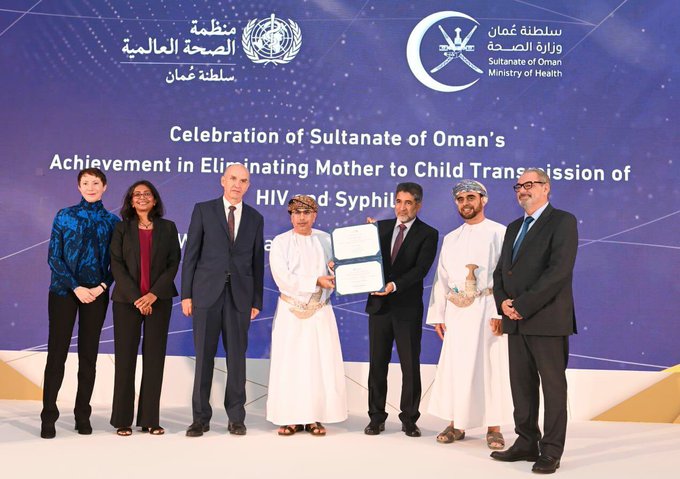

MUSCAT: The Sultanate of Oman received the global certificate for elimination of mother-to-child transmission of HIV and syphilis (EMTCT) here at Al Bustan Palace Hotel on Thursday.
Oman, thus, became the first country in the Eastern Mediterranean Region to obtain this global certificate in a ceremony in which the Director-General of the World Health Organization (WHO) presented a speech in which he congratulated the Sultanate for becoming the 16th country in the world to obtain this rare honour.
Dr. Hilal bin Ali Al-Sabti, Minister of Health, said that this achievement is one of the great successes and a step forward for the advancement of health services in the Sultanate which is taking clear steps to advance the services to achieve comprehensive health for every citizen and resident.
Read More
- New Musandam road to cut Khasab–Dibba travel to 55 minutes for commuters in Oman
- Oman Across Ages Museum welcomes one million visitors
- Oman introduces new rules for telecom networks inside buildings
- New Oman rules issued to make switching telecom providers faster
- 2,763kg of expired fish seized in Oman over alleged date manipulation
Dr. Saif bin Salem Al-Abri, Director General of Disease Control and Control at the Ministry of Health and Chairman of the National Committee to Verify the Transmission of HIV and Syphilis from Mother to Child, said that this achievement is a translation of the efficiency of the health system in the Sultanate, and the quality of services provided by health institutions in the country.
“It was a team effort of institutional and individual work that was carefully planned and executed perfectly backed by a scientific methodology. Local, regional and global experts too joined to ensure the achieved desired results,” Al Abri said in his speech.
The commitment of the government of the Sultanate of Oman to provide the best health services to all citizens and residents is guided by the Oman 2040 vision.
“The task will not end after achieving this achievement, rather it is just the beginning of a new phase of work to improve public health programs benefiting from this experience and that the Sultanate is determined to eliminate HIV, hepatitis and sexually transmitted diseases by 2030,” he added.
Dr. Tedros Adhan, D-G of the WHO, in a recorded speech, congratulated the Sultanate of Oman for being the first country in the Eastern Mediterranean to obtain the recognition of the UN body and noted that this success would not have been achieved without exceptional political commitment.
“This huge achievement requires continued support for large-scale efforts to prevent the transmission of HIV and syphilis to all the population and that the Sultanate of Oman can at the same time benefit from this success to work on eliminating the transmission of hepatitis C,” he said and offered WHO’s support for the Sultanate to strengthen its health system and provide comprehensive services to ensure the protection of the rights of women infected with HIV or hepatitis B disease and to involve women in providing health services and plans.
Dr. Ahmed bin Salem Al-Mandhari, WHO Regional Director for the Eastern Mediterranean, said that this great achievement is evidence of the Sultanate’s commitment to implement data-based public health interventions and to ensure that all women with HIV and their children have access to services without any discrimination, expressing the hope that the Sultanate will now lead in the region to promote public health and human rights.
Adele Khader, the Regional Director of the United Nations Children’s Fund (UNICEF) in the Middle East and North Africa, expressed her pride and happiness that the Sultanate is the first country in the Middle East and North Africa to achieve this dual achievement.
“Globally, there has been remarkable progress over the past decade in providing antiretroviral treatment to pregnant women living with HIV, to the extent that in 2021, 81% of infected pregnant women received antiretroviral drugs to prevent transmission of the virus to their children,” she said in her speech.
Dr. Sherine Al-Fiqi, the Regional Director of the United Nations AIDS Program, also congratulated the Sultanate on this important achievement.
At the end of the ceremony, the team involved in the project was honored.
The achievement of the Sultanate is expected to motivate other countries in the region, especially the Gulf Cooperation Council (GCC) states.





