
MUSCAT: Art is making a comeback for sure! After the pandemic blues, we are back to the normal course of life and all creative activities are now gaining momentum. Of course, the art market had started showing the sign of a comeback in early 2021 but now it has further gained strength if the latest auctions by renowned auction house Sotheby’s are any indication.
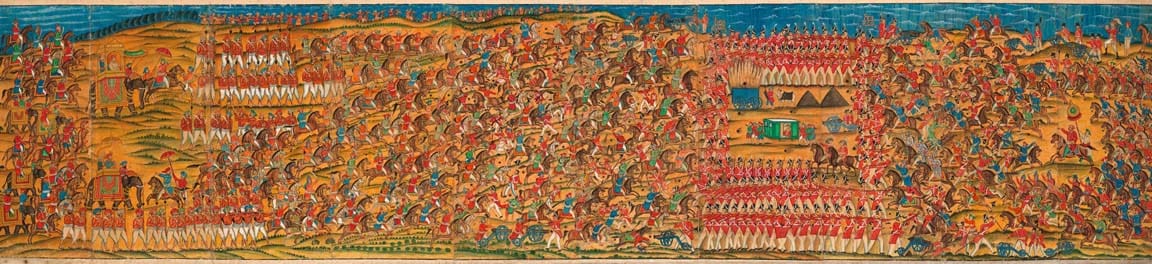
The latest is that a painting, ‘The Battle of Pollilur’, depicting the historic victory of Mysore ruler Haider Ali and his son Tipu Sultan over the East India Company in September 1780 was sold for a whopping 630,000 pounds on Wednesday.
It is said that Tipu Sultan, the last ruler of Mysore, commissioned the local artists to do a panoramic picture of the Battle of Pollilur.
Read More
- Dubai to roll out ‘Rent Now, Pay Later’ plan with 12-month, zero-interest payments
- Cholera surge puts millions of children at risk across Africa, UNICEF warns
- Qatar permanently bans 27 individuals from healthcare sector over fake certificates
- Historic solar eclipse to cross Europe as Spain awaits first total eclipse in more than a century
- Nepal: Bodies of three elite Nepali climbers killed in Broad Peak avalanche arrive in Kathmandu
The 32ft-long painting, gouache on paper, is done on 10 sheets of paper, and it depicts Tipu atop an elephant while overseeing his troops. There is also the portrayal of the British soldiers struggling against the Mysore army, and the cavalry of Tipu attacking the Company forces.
According to historian William Dalrymple, who wrote the catalogue note for this auction, “The Battle of Pollilur is undoubtedly one of the great masterpieces of the period: a panorama of one of the crucial turning points of Indian history realised with extraordinary vivacity and energy that has few rivals in the art of the period.”
The way Tipu’s cavalry advances from left and right, as depicted in this painting, is “like waves of an angry sea,” he says quoting contemporary Mughal historian Ghulam Husain Khan.
Arguably the greatest Indian picture of the defeat of colonialism that survives, this artwork was first commissioned by Tipu himself in 1784 as a visual record of the battle and to commemorate his victory. They were painted on the walls and frescoes of his palace – Daria Daulat Bagh – in Srirangapatnam, then the capital of Mysore.
“Tipu was understandably proud of his victory and was quick to commemorate it with a mural which still remains, albeit faded and much repainted, on the sidewall of his pleasure palace at Darya Daulat Bagh, which lies above the banks of Cauvery River on the north side of his great fortified island fortress of Srirangapatnam. It is a slightly later copy of the lower central-right section of that mural, painted at some point between 1799 and around 1820, that Sotheby’s now brings to auction, says the note.
Three existing copies of the original Pollilur painting are known, according to the auction house. Three details in a miniature in the Baroda Museum, 24 preparatory paintings depicting sections of the series, and the complete panorama sold this week, comfortably beating its lowest guide price of 500,000 pounds.
The painting depicts in detail what happened on the morning of September 7, 1780, when Tipu ambushed Company forces led by Colonel William Bailie near a village named Pollilur not far from Madras (now Chennai), which was a major British trading outpost at the time.
“The painting extends over ten large sheets of paper, nearly thirty-two feet (978.5 cm) long, and focuses on the moment when the Company’s ammunition tumbril explodes, breaking the British square, while Tipu’s cavalry advances from left and right, “like waves of an angry sea”, according to Ghulam Husain Khan. The pink-cheeked and rather effeminate-looking Company troops wait fearfully for the impact of the Mysore charge, as the gallant and thickly moustachioed Mysore lancers close in for the kill,” says the note.
Sotheby’s auctioned this painting and other works under ‘Arts of the Islamic World & India including Fine Rugs and Carpets’.





