
Amidst the gathering, I stood out in my Omani attire, a contrast to the trousers and shirts worn by the others, and this setting evoked memories of bygone decades.
In this colorful assembly, an array of games and activities unfolded beyond the confines of the coffee shop. It was heartening to witness laborers, who had toiled tirelessly throughout the day, relishing their evenings by engaging in such recreations.
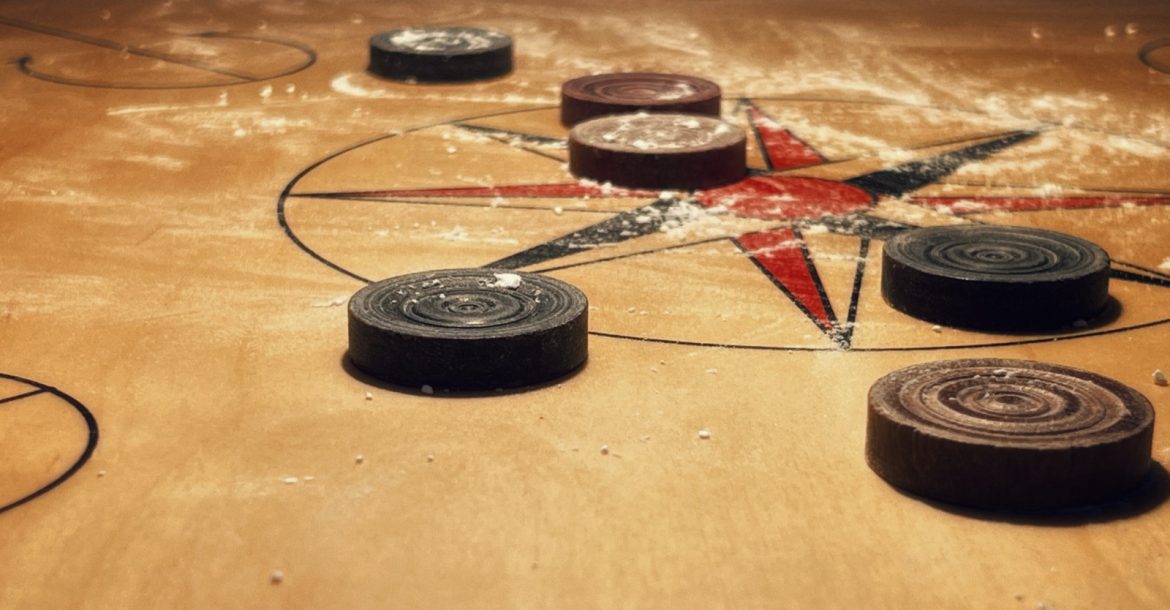
Among them, a particular group was engrossed in the carrom board, while others were deeply engrossed in a game of ‘play cards’.
Read More
- What Shakespeare knew about economics before economists did
- Respect is earned, not expected: Rethinking the teacher-student relationship
- Never underestimate a woman who enjoys her own company
- Rethinking schooling in the age of Artificial Intelligence
- Reeling from endless social media content? Pause the doomscroll, rewind to screen-free time
Curiosity sparked within me, and I mustered the courage to ask, “May I join you?” A warm smile greeted my query, and a gentleman responded, “Of course, come and join us.” Finding my place around the table, I eagerly joined the game.
The mechanics of this tabletop sport involved skillfully flicking discs, aiming to guide them into the board’s corners. I jestingly added, “Please pardon any lack of skill on my part,” ensuring a light-hearted tone. A fellow player kindly advised, “Focus on the black coins.”
In the intriguing realm of carrom, eighteen coins—nine black, nine white—graced the board, accompanied by a red ‘queen’ coin and a striker.
Inquisitive about the frequency of their play, I inquired, “How often do you indulge in this game?” With a contented grin, one player replied, “Almost every day. It’s both enjoyable and a wonderful way to gather.”
Reflecting on its origins, it is, perhaps, pertinent to note that historical records indicate that carrom tournaments may have originated in Sri Lanka around 1935. By 1958, both India and Sri Lanka had established official federations for carrom clubs, organizing tournaments and bestowing honors.
Furthermore – and according to the research – it was found that the International Carrom Federation (ICF) emerged in 1988 in Chennai, India. The formal regulations for the Indian iteration of the game were unveiled the same year, officially codifying the rules.
This pastime has flourished across South Asia, particularly in India, Pakistan, Bangladesh, Sri Lanka, Nepal, and the Maldives. It has also garnered popularity in the Arabian Peninsula nations like Saudi Arabia, Kuwait, and Bahrain, as per my limited internet exploration.
The game’s influence has even reached the United Kingdom, Europe, North America, and Australia through the Indian diaspora, prompting the establishment of the UK Carrom Federation in 1991 in London.





